




Cold Room Condensing Units
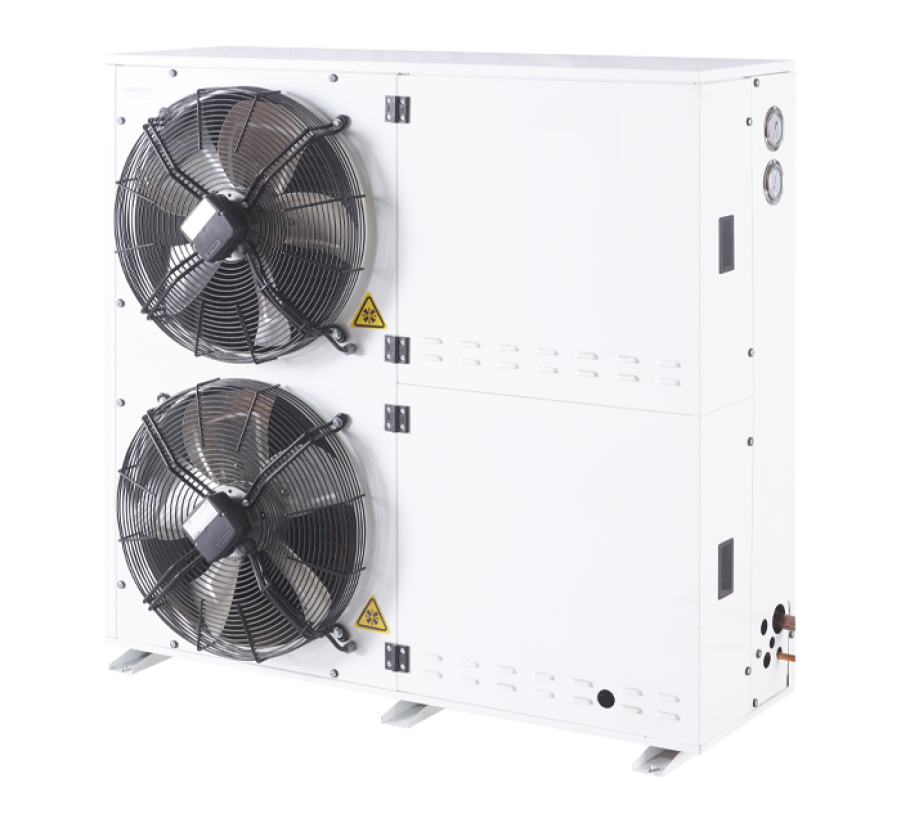
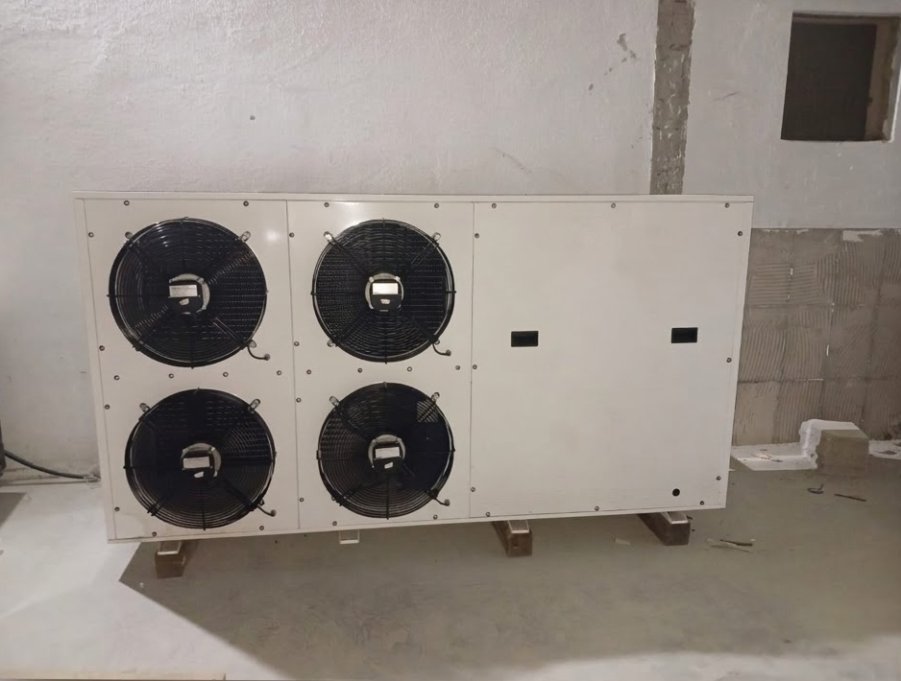
A cold room condensing unit is a refrigeration assembly that compresses refrigerant, rejects absorbed heat, then supplies refrigerant back toward an evaporator inside a refrigerated room. It forms one of the main components of a remote cold room refrigeration system.
Freezewize Cold Room Condensing Units are designed for walk-in coolers, chilled cold rooms, food storage, supermarkets, restaurants, food processing facilities, cold storage warehouses, pharmaceutical rooms, plus commercial refrigeration projects.
Each condensing unit is selected around actual cooling load, target room temperature, ambient conditions, product load, door traffic, evaporator requirements, installation location, plus regional refrigerant requirements. This project-based approach helps match refrigeration capacity with real cold room operating conditions instead of relying only on room volume.
Condensing Unit Basics
A cold room refrigeration system moves heat from inside refrigerated space to surrounding environment.
The evaporator absorbs heat inside cold room.
The condensing unit handles refrigerant compression plus heat rejection outside refrigerated space.
A typical remote system follows this basic path:
Evaporator → Compressor → Condenser → Liquid Line → Expansion Device → Evaporator
This closed refrigeration circuit continuously moves thermal energy away from stored products.
A condensing unit therefore does not simply “produce cold.”
Its primary role is to move refrigerant through refrigeration cycle while rejecting collected heat to ambient conditions.
Unit Configuration
| Technical Feature | Freezewize Configuration |
|---|---|
| Product Type | Cold Room Condensing Unit |
| System Category | Remote refrigeration equipment |
| Primary Application | Medium-temperature cold rooms |
| Main Markets | Walk-In Coolers / Cold Storage / Food Refrigeration |
| Core Components | Compressor / Condenser Coil / Electrical Components |
| Heat Rejection | External refrigeration circuit |
| Evaporator Integration | Selected according to refrigeration duty |
| Refrigerant | Region-appropriate refrigerant supply |
| Installation | Outdoor or technical/machine-room arrangement according to project |
| Capacity Selection | Cooling-load based |
| Ambient Selection | Project-specific |
| Electrical Configuration | Project-specific |
| Controls | Selected according to refrigeration system |
| Production | Project-specific configuration |
Exact refrigeration capacity, compressor configuration, voltage, refrigerant, condenser dimensions, controls, plus electrical components need confirmation during technical selection.
Condensing Unit Function
A refrigeration condensing unit performs two major functions.
Refrigerant Compression
Compressor receives low-pressure refrigerant vapor returning from evaporator.
Compression increases refrigerant pressure plus temperature.
This prepares refrigerant for heat rejection.
Heat Rejection
Hot refrigerant then moves through condenser.
Condenser transfers absorbed heat toward surrounding environment.
Refrigerant changes condition before continuing toward expansion device plus evaporator.
This process repeats while cold room requires cooling.
Proper condensing unit selection helps refrigeration system maintain target temperature under changing operating loads.
Condensing Unit Components
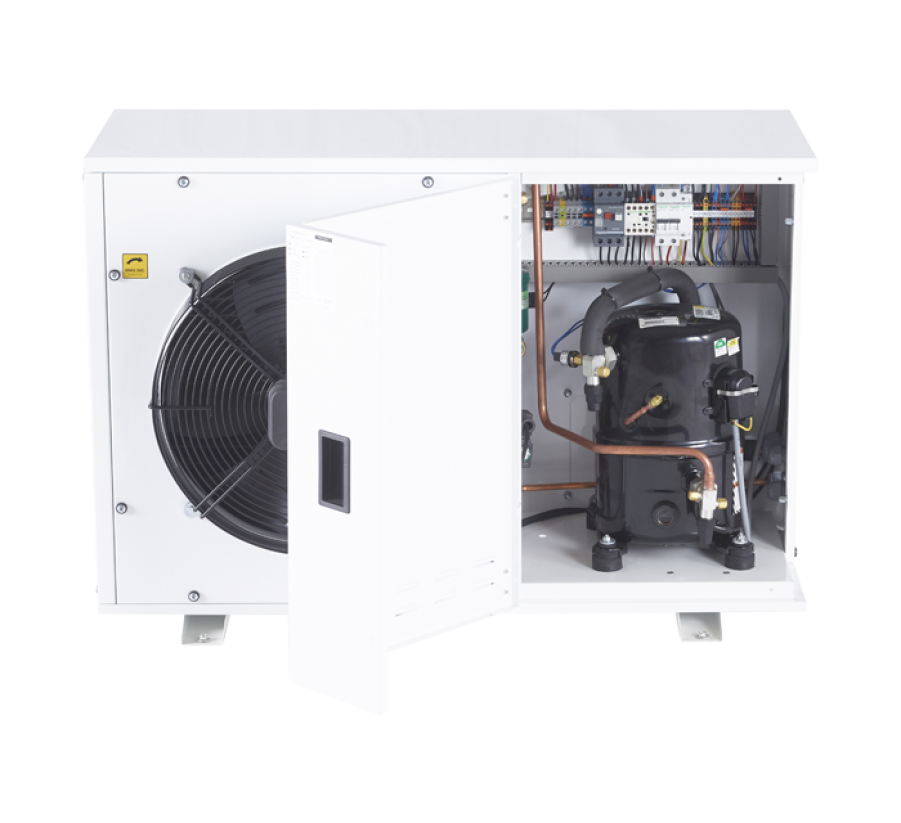
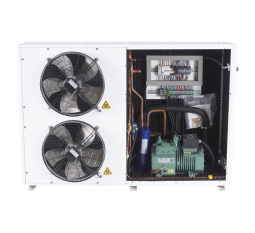
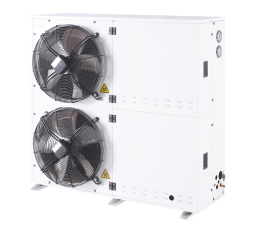
A cold room condensing unit combines several refrigeration components into one external assembly.
Typical Freezewize configuration includes:
Compressor
Compressor circulates refrigerant through refrigeration circuit.
Its capacity needs to match actual refrigeration duty.
Condenser Coil
Condenser coil transfers refrigerant heat toward surrounding environment.
Coil performance becomes especially important in high ambient conditions.
Condenser Fans
Fans move ambient air across condenser surface where air-cooled configuration is used.
Airflow needs sufficient space around installed unit.
Electrical Components
Electrical components support compressor operation, fan control, system protection, plus refrigeration sequencing.
Refrigerant Circuit Components
Additional refrigeration components are selected according to project architecture, refrigerant, capacity, plus control strategy.
Final component list depends on selected condensing unit configuration.
Condenser vs Condensing Unit
These terms are often confused.
A condenser is a heat exchanger.
A condensing unit is a larger refrigeration assembly containing a compressor plus condenser system, along with supporting refrigeration or electrical components according to configuration.
| Component | Primary Function |
|---|---|
| Condenser | Rejects refrigerant heat |
| Compressor | Compresses plus circulates refrigerant |
| Condensing Unit | Combines compressor, condenser, plus supporting components |
This distinction matters when requesting quotations.
A customer asking only for a condenser may be looking for a heat exchanger.
A customer asking for a cold room condensing unit usually needs compressorized refrigeration equipment designed to operate with an evaporator.
Remote Refrigeration System
Cold Room Condensing Units normally form part of a remote refrigeration system.
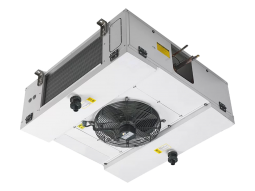
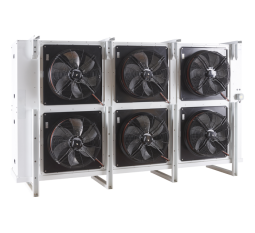
Evaporator sits inside cold room.
Condensing unit sits outside refrigerated enclosure, on a roof, beside a building, or inside a suitable technical area.
Refrigerant piping connects both sides.
This arrangement moves condenser heat away from cold room.
A remote configuration also allows more flexibility around:
- Equipment location
- Service access
- Noise
- Refrigeration capacity
- Evaporator placement
- Cold room layout
Installation location still affects final system design.
Walk-In Cooler Condensing Unit
A walk-in cooler condensing unit needs to match actual refrigeration duty rather than only cooler dimensions.
Two walk-in coolers with identical dimensions can require different cooling capacities.
Reasons include:
- Different ambient temperature
- Different panel insulation
- Different product load
- Different incoming product temperature
- Different door traffic
- Different operating schedule
- Different lighting
- Different personnel load
- Different evaporator design
For example, a storage cooler receiving already chilled products creates a different refrigeration load from a food-processing room receiving warm product several times per day.
Room size alone cannot describe these differences.
Cooling Load Selection
Correct condensing unit sizing starts with cooling-load calculation.
Important inputs include:
Transmission Load
Heat enters through insulated walls, ceiling, floor, plus doors.
Product Load
Products arriving above room temperature release heat while cooling.
Infiltration Load
Warm air enters when doors open.
Internal Load
Lighting, evaporator fans, people, motors, plus equipment add heat.
Ambient Conditions
Outdoor or machine-room temperature affects condenser performance.
Pull-Down Requirement
Some applications need products or room temperature reduced within a defined time.
All these loads contribute to required refrigeration capacity.
A condensing unit selected only from room volume risks oversizing or undersizing.
Product Load
Product load becomes especially important in food refrigeration.
Consider two identical cold rooms.
Room A stores products already at required temperature.
Room B receives several thousand pounds of warm food every day.
Room B requires significantly more refrigeration capacity.
Engineering needs to know:
- Product type
- Incoming temperature
- Storage temperature
- Product quantity
- Loading frequency
- Required cooling time
These values influence cold room condensing unit capacity.
Door Traffic
Cold room doors create temporary openings between refrigerated space plus warmer surrounding air.
Every opening introduces:
- Sensible heat
- Moisture
- Additional cooling load
A restaurant walk-in cooler opened hundreds of times per day creates different refrigeration demand from a warehouse room opened only several times.
Condensing unit selection should therefore consider:
- Door size
- Opening frequency
- Opening duration
- Traffic type
- Ambient conditions around doorway
High traffic can significantly change required refrigeration duty.
Ambient Temperature
Condensing unit performance depends strongly on ambient conditions around condenser.
A system installed outdoors in a hot climate operates under different conditions from one located in a mild environment.
High surrounding temperature reduces condenser's ability to reject heat.
This makes design ambient temperature important.
Freezewize international projects need to consider installation location individually.
A condensing unit for Texas, Florida, Arizona, Northern Europe, or a controlled machine room should not automatically use identical selection conditions.
High Ambient Operation
High ambient projects require careful condenser selection.
Potential conditions include:
- Rooftop installation
- Direct summer heat
- Restricted airflow
- Industrial machine rooms
- Hot climates
- Nearby heat-producing equipment
A condensing unit selected only at mild rating conditions may provide insufficient capacity under hotter real operating conditions.
Performance data should therefore be evaluated at expected project ambient temperature.
This is especially important across U.S. regions with high summer design temperatures.
Unit Location
Condensing unit location affects both refrigeration performance plus serviceability.
Common locations include:
- Ground-level exterior
- Rooftop
- Exterior equipment platform
- Technical room
- Machine room
Each creates different design conditions.
Outdoor Installation
Needs sufficient airflow plus suitable weather protection.
Rooftop Installation
Needs structural support, service access, plus high-ambient evaluation.
Technical Room
Needs ventilation capable of removing condenser heat.
Ground-Level Installation
Needs protected clearance plus service access.
Location should be established before final condensing unit selection.
Airflow Clearance
A condenser needs access to ambient air.
Restricted airflow reduces heat rejection.
Problems can develop when a condensing unit sits:
- Too close to walls
- Inside a poorly ventilated enclosure
- Beside another condenser discharge
- Under a low obstruction
- Near hot exhaust air
Recirculating hot condenser air increases entering-air temperature.
Higher inlet temperature can reduce refrigeration performance plus increase compressor stress.
Equipment layout should therefore protect condenser intake plus discharge airflow.
Condensing Unit Noise
Equipment location also influences acoustic impact.
Condensing units contain compressors plus fans.
Noise becomes more relevant near:
- Restaurants
- Hotels
- Residential buildings
- Retail stores
- Office spaces
- Property boundaries
Noise requirements should be identified during project design.
Possible solutions depend on unit configuration, equipment location, fan selection, structure, plus surrounding building conditions.
Noise should be treated as a site-selection factor rather than an after-installation surprise.
Cooler vs Freezer Units
Medium-temperature cooler condensing units plus low-temperature freezer condensing units operate under different refrigeration conditions.
| Selection Factor | Cooler Condensing Unit | Low-Temperature Unit |
|---|---|---|
| Primary use | Chilled storage | Frozen storage |
| Refrigeration duty | Medium temperature | Low temperature |
| Compressor operating conditions | Cooler duty | Freezer duty |
| Evaporator temperature | Higher | Lower |
| Defrost requirement | Application dependent | More demanding |
| Selection method | Cooling-load based | Cooling-load plus low-temp duty |
This page primarily addresses Cold Room Condensing Units for cooler plus chilled applications.
Freezer-focused projects should use Freezewize Low-Temperature Condensing Units, where compressor duty, evaporating conditions, defrost strategy, plus low-temperature operation receive dedicated engineering attention.
This separation keeps product selection clear.
Condensing vs Monoblock
A condensing unit system differs from a monoblock refrigeration unit.
Condensing Unit System
Condensing unit sits outside cold room.
Separate evaporator sits inside.
Refrigeration piping connects both components.
Monoblock Unit
Major refrigeration components are integrated into a compact packaged assembly.
| Project Factor | Condensing Unit | Monoblock Unit |
|---|---|---|
| Remote condenser section | Yes | Integrated |
| Separate evaporator | Yes | Integrated assembly |
| Refrigerant piping | Required | Reduced site piping |
| Installation flexibility | High | Compact |
| Equipment location flexibility | High | More fixed |
| Small cold rooms | Suitable | Strong application |
| Larger cooling duties | Strong application | Model dependent |
Neither system is universally better.
Correct architecture depends on capacity, room size, installation conditions, maintenance access, plus project layout.
Evaporator Matching
A cold room condensing unit does not operate independently.
It needs a compatible evaporator.
Matching needs to consider:
- Refrigeration capacity
- Refrigerant
- Evaporating condition
- Room temperature
- Coil design
- Airflow
- Defrost strategy
- Expansion device
An oversized evaporator paired with a poorly matched condensing unit does not automatically create better cooling.
Likewise, a powerful condensing unit cannot compensate for insufficient evaporator airflow.
Both sides of refrigeration circuit need compatible selection.
Evaporator Airflow
Condensing unit provides refrigeration capacity.
Evaporator distributes cooling inside room.
Poor airflow can produce:
- Warm spots
- Slow product cooling
- Uneven room temperature
- Compressor cycling
- Increased operating time
Before blaming condensing unit, system diagnosis should check evaporator airflow plus product placement.
Cold room performance depends on entire refrigeration loop.
Refrigerant Strategy
Refrigerant selection now varies significantly by market.
Freezewize does not use one universal refrigerant for every country.
Each condensing unit is configured around region-appropriate refrigerant supply, technical compatibility, application requirements, plus applicable local regulations.
Refrigerant selection influences:
- Compressor compatibility
- Expansion device
- Pressure controls
- Piping design
- Safety requirements
- Service availability
- Long-term market suitability
This is especially important in international projects.
A refrigeration configuration selected for one region should not automatically be copied into another market.
U.S. Project Selection
U.S. walk-in cooler projects also require attention to applicable efficiency rules plus local equipment requirements.
For certain walk-in cooler/freezer applications, U.S. Department of Energy requirements use Annual Walk-In Energy Factor (AWEF) ratings when determining minimum equipment efficiency.
Freezewize should therefore evaluate applicable project requirements before final U.S. condensing unit specification rather than make a universal compliance statement across every configuration.
Required information includes:
- Cooler or freezer application
- Indoor or outdoor equipment location
- Refrigeration capacity
- Electrical supply
- Installation state
- Refrigerant strategy
- Equipment configuration
This creates a safer, more technically accurate U.S. sales process.
Electrical Configuration
Condensing unit electrical requirements need coordination with installation site.
Project information should include:
- Voltage
- Phase
- Frequency
- Available electrical capacity
- Local electrical requirements
- Control-panel arrangement
U.S. electrical supply differs from many European projects.
Incorrect voltage information during quotation can result in incompatible equipment.
Electrical data should therefore be confirmed before manufacturing.
Compressor Selection
Compressor represents core mechanical component inside a condensing unit.
Correct compressor selection depends on refrigeration duty.
Important inputs include:
- Refrigeration capacity
- Evaporating condition
- Condensing condition
- Refrigerant
- Ambient temperature
- Electrical supply
- Operating profile
Compressor should not be selected only by horsepower.
Two compressors with similar nominal horsepower can provide different refrigeration capacity under different operating conditions.
Performance needs to be evaluated at actual application duty.
Condenser Capacity
Condenser rejects both:
- Heat absorbed inside cold room
- Heat added through compressor operation
This means condenser heat rejection is greater than cold room refrigeration capacity alone.
Condenser sizing therefore needs to match compressor plus operating conditions.
High ambient temperature increases importance of correct condenser selection.
A dirty or restricted condenser also reduces heat rejection during operation.
Service Access
A well-selected condensing unit still needs maintainable installation.
Technicians require access to:
- Compressor
- Electrical panel
- Condenser
- Fans
- Valves
- Service connections
Installing equipment in a tight space may reduce installation footprint but increase future service time.
Good project design leaves sufficient service clearance around equipment.
This becomes especially important on rooftops or narrow technical platforms.
Condenser Maintenance
Condenser performance changes when airflow surfaces become dirty.
Dust, grease, debris, plus environmental contamination can reduce heat transfer.
Maintenance teams should periodically inspect:
- Condenser coil
- Fan operation
- Electrical components
- Refrigerant condition
- Operating pressures
- Unusual noise
- Vibration
A condensing unit struggling with dirty condenser surface can show symptoms similar to an undersized system.
Diagnosis should therefore include equipment condition.
Short Cycling
Frequent compressor starts plus stops are known as short cycling.
Possible causes include:
- Oversized refrigeration capacity
- Control problems
- Refrigerant issues
- Low load
- Sensor problems
- Pressure-control events
Short cycling can reduce operating stability plus increase mechanical stress.
Correct condensing unit sizing helps avoid one common contributor: excessive capacity relative to real room load.
Larger is not automatically better.
Undersized Condensing Units
An undersized condensing unit may struggle during peak load.
Typical symptoms include:
- Slow temperature recovery
- Long compressor run time
- Difficulty reaching setpoint
- Temperature rise after loading
- Poor performance during hot weather
However, these symptoms can also come from:
- Air leaks
- Door problems
- Dirty condenser
- Evaporator icing
- Poor airflow
- Refrigerant issues
System diagnosis should confirm cause before replacing equipment.
Oversized Condensing Units
Oversizing also creates problems.
An oversized unit may:
- Cycle frequently
- Reduce control stability
- Increase initial equipment cost
- Operate outside preferred load conditions
Correct selection aims for appropriate refrigeration capacity, not maximum available capacity.
This is why Freezewize bases unit selection on cooling-load engineering.
Product Pull-Down
Storage cooling plus product pull-down are not identical duties.
A cold room holding already chilled food may need mainly to offset ongoing heat gain.
A room receiving warm products must remove additional product heat.
Required pull-down time further changes capacity requirement.
For applications involving warm incoming products, customer should provide:
- Product type
- Product mass
- Incoming temperature
- Final temperature
- Loading frequency
- Required pull-down time
This information helps determine whether a standard storage-duty condensing unit is suitable.
Cold Storage Applications
Freezewize Cold Room Condensing Units support applications such as:
Walk-In Coolers
Restaurants, hotels, supermarkets, grocery stores, commercial kitchens, plus foodservice operations.
Food Storage
Meat, dairy, beverages, produce, prepared food, plus packaged products.
Food Processing
Temperature-controlled storage or production support rooms.
Cold Chain Logistics
Chilled staging, storage, picking, plus distribution areas.
Pharmaceutical Storage
Temperature-controlled product rooms requiring stable cooling conditions.
Refrigerated Warehouses
Medium-temperature storage facilities with project-specific refrigeration loads.
Application type influences final unit selection.
Selection Data Required
Before selecting a cold room condensing unit, Freezewize needs accurate project information.
Cold Room Dimensions
Length, width, height.
Target Temperature
Required room operating temperature.
Ambient Temperature
Expected temperature around condensing unit.
Product Type
Food, beverage, pharmaceutical, produce, or other stored material.
Product Load
Daily product quantity plus incoming temperature.
Door Traffic
Opening frequency plus door size.
Panel Insulation
Wall, ceiling, plus floor construction.
Equipment Location
Outdoor, rooftop, machine room, or technical area.
Electrical Supply
Voltage, phase, plus frequency.
Refrigerant Requirement
Selected according to region plus project compatibility.
Pull-Down Requirement
Required only where product temperature needs rapid reduction.
These inputs provide a much stronger technical basis than requesting horsepower alone.
Complete Refrigeration System
A Cold Room Condensing Unit operates as part of a larger refrigeration system.
Complete system can include:
- Cold Room Condensing Unit
- Cold Room Evaporator
- Expansion device
- Refrigerant piping
- Electrical controls
- Sensors
- Drainage
- Cold room panels
- Cold room doors
Every component needs compatible engineering.
This gives the product a clear place within Freezewize's new category:
Cold Room Refrigeration Systems
→ Cold Room Condensing Units
→ Cold Room Evaporators
→ Controls plus refrigeration circuit
→ Complete cold room operation
Turnkey Unit Integration
Freezewize Cooling System supplies Cold Room Condensing Units individually or integrates refrigeration equipment into complete cold storage projects.
Turnkey scope includes:
- Project design
- Cooling-load calculation
- Condensing unit selection
- Cold room evaporators
- Refrigeration piping
- Insulated cold room panels
- Cold room doors
- Electrical controls
- Automation
- Installation
- Testing
- Commissioning
- Final handover
This integrated approach allows condensing unit capacity, evaporator selection, room insulation, ambient temperature, product load, door traffic, refrigerant strategy, electrical supply, plus installation location to be evaluated as one refrigeration system.
For walk-in coolers, chilled food storage, supermarkets, restaurants, food processing facilities, cold chain operations, or refrigerated warehouses, contact Freezewize Cooling System to specify a cold room condensing unit around actual cooling load, room temperature, ambient conditions, electrical requirements, and operating profile.
Gallery