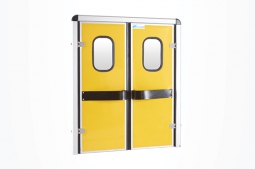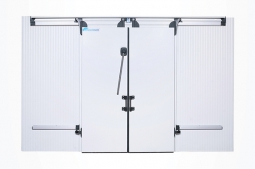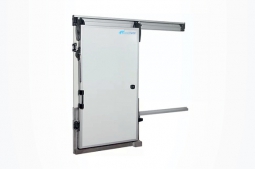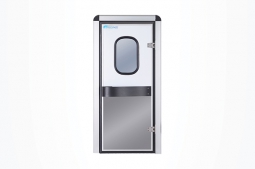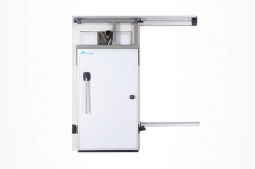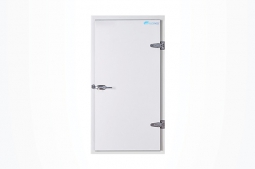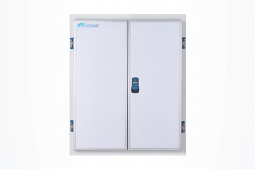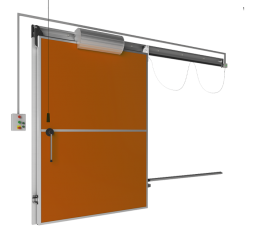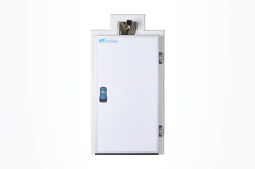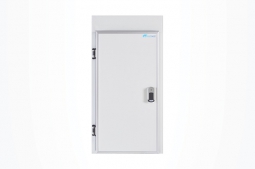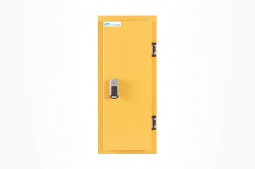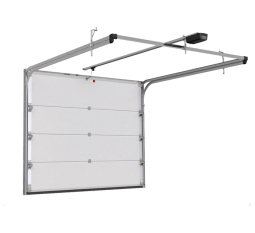





Automatic Sliding Cold Room Door
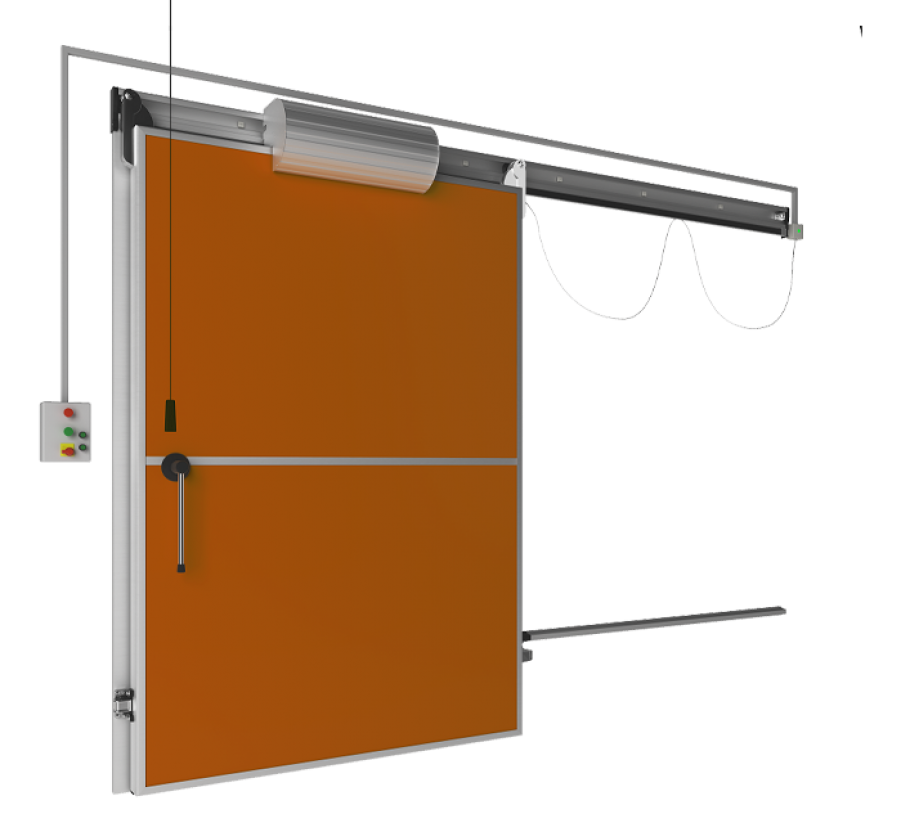
An automatic sliding cold room door is a motorized insulated door designed for high-traffic cold rooms, walk-in coolers, walk-in freezers, food processing facilities, logistics warehouses, and industrial cold storage operations. Freezewize Automatic Sliding Cold Room Door combines horizontal door movement with an industrial electric motor, automated controls, polyurethane insulation, thermal sealing, obstacle detection, plus manual emergency release.
Unlike a manual sliding door, an automatic cold room door opens through push button, motion sensor, or remote control commands. Fast controlled access reduces manual handling at busy entrances while helping limit unnecessary opening time between refrigerated space and ambient areas.
Freezewize manufactures each automatic sliding cold room door according to room temperature, clear opening dimensions, traffic frequency, door thickness, control method, surface requirement, plus project layout.
Automatic Door Specifications
| Technical Feature | Freezewize Specification |
|---|---|
| Product Type | Automatic Sliding Cold Room Door |
| Door Configuration | Motorized horizontal sliding door |
| Application | Cold Room / Freezer / Industrial Cold Storage |
| Insulation Core | High-density polyurethane foam |
| PU Density | 40–45 kg/m³ |
| Thermal Conductivity | ≤ 0.022 W/m·K |
| 80 mm Thickness | R-20 |
| 100 mm Thickness | R-25 |
| 120 mm Thickness | R-30 |
| 150 mm Thickness | R-38 |
| U-Value at 150 mm | Approx. 0.15 W/m²K |
| Surface Options | Pre-coated galvanized steel / AISI 304 stainless steel |
| Drive System | Industrial electric motor with gear system |
| Control Options | Push button / Motion sensor / Remote control |
| Sealing System | Magnetic seal |
| Low-Temperature Option | Heated frame available |
| Frame Construction | Insulated aluminum / stainless steel |
| Operating Range | +2°C to −40°C / 35.6°F to −40°F |
| Opening Speed | Adjustable according to project configuration |
| Safety System | Obstacle detection |
| Emergency Operation | Manual emergency unlocking |
| Automation Duty | Designed for high-frequency industrial use |
| Production | Fully customized according to project dimensions |
Automatic Cold Room Access
An automatic cold room door is primarily selected when door traffic becomes part of facility productivity.
Manual doors require an operator to stop, reach a handle, move the door, pass through, then close it correctly. That process may be acceptable at a low-cycle entrance.
A busy cold storage facility creates different conditions.
Forklift operators, warehouse teams, production personnel, mobile racks, carts, or pallet movements may cross one refrigerated opening repeatedly throughout each shift.
An automatic sliding cold room door allows access to begin through a control signal rather than direct manual handling.
Depending on project configuration, activation can use:
- Push button
- Motion sensor
- Remote control
This automated movement supports faster access while reducing unnecessary physical contact with door surfaces.
Motorized Sliding System
A motorized cold room door depends on more than adding an electric motor to a manual sliding door.
Door weight, opening dimensions, travel distance, cycle frequency, acceleration, closing behavior, rail alignment, plus safety controls all affect automatic operation.
Freezewize uses an industrial electric motor with gear system designed for automatic horizontal movement.
Motorized operation provides repeatable door travel rather than relying on different users to open or close a large insulated door with varying force.
This becomes important in:
- Large cold storage warehouses
- Food processing facilities
- Distribution centers
- Frozen food warehouses
- Logistics operations
- Pharmaceutical cold storage
- High-capacity walk-in coolers
- Industrial freezer rooms
Automatic door specification needs to match actual cycle demand. A door opening occasionally has different motor requirements from an entrance operating continuously during receiving or dispatch shifts.
High-Cycle Door Operation
High traffic changes cold room door requirements.
An automatic sliding cold room door serving frequent movement needs to perform hundreds of repeated actions without losing alignment, sealing position, or predictable control behavior.
Important high-cycle factors include:
Motor Duty
Drive system needs to correspond with expected opening frequency.
Door Weight
Thicker insulated leaves or large stainless steel doors increase moving mass.
Travel Distance
Wide openings require longer lateral movement.
Opening Speed
Faster movement may improve access, but speed needs to remain compatible with safety and door dimensions.
Closing Delay
Door should remain open long enough for safe passage without staying open unnecessarily.
Sensor Position
Activation needs to correspond with real traffic direction.
Maintenance Access
Motor, rail, controls, plus safety components need practical service access.
For this reason, automatic operation should be designed around traffic data rather than treated as a decorative upgrade.
Automatic Freezer Door
Freezewize Automatic Sliding Cold Room Door also supports low-temperature applications down to −40°C (−40°F)when configured for freezer conditions.
This allows the same product family to serve:
Walk-In Coolers
Positive-temperature cold storage requiring frequent automated access.
Walk-In Freezers
Frozen storage where insulation, sealing, plus frost control become stronger requirements.
Industrial Freezer Rooms
Larger low-temperature facilities handling pallets, racks, or frequent product movement.
Frozen Warehouses
High-capacity frozen storage operations requiring automated material access.
For low-temperature projects, door thickness, frame heating, sealing, threshold conditions, plus moisture control need to be considered together.
This is why automatic sliding freezer door specification cannot rely only on opening dimensions or motor power.
Insulated Door Performance
An automated door still forms part of cold room insulation.
Freezewize uses high-density polyurethane foam with 40–45 kg/m³ density and thermal conductivity of ≤ 0.022 W/m·K.
Available insulation levels include:
80 mm — R-20
Suitable for selected cooler and refrigerated applications.
100 mm — R-25
Provides increased resistance for demanding cold storage conditions.
120 mm — R-30
Suitable for stronger refrigeration and low-temperature requirements.
150 mm — R-38
Designed for high-performance freezer applications.
At 150 mm thickness, specified U-value is approximately 0.15 W/m²K.
Door thickness should correspond with room temperature, insulated wall system, ambient climate, opening frequency, plus refrigeration design.
Automation does not replace thermal performance. Both systems need to work together.
Automatic Door Sealing
Every opening cycle temporarily connects refrigerated space with surrounding ambient air.
Once passage ends, an automatic cold room door needs to return consistently to its designed closed position.
Freezewize uses magnetic sealing with an optional heated frame for low-temperature configurations.
Consistent closure helps reduce uncontrolled air movement after each cycle.
Poor sealing can contribute to:
- Cold air loss
- Warm air infiltration
- Temperature fluctuation
- Condensation
- Frost
- Increased refrigeration load
- Gasket wear
- Product-storage instability
Automatic closing offers an operational advantage because door closure no longer depends entirely on personnel remembering to close a manual entrance.
However, automation only performs correctly when motor control, rail alignment, closing position, plus sealing geometry remain properly coordinated.
Door Opening Control
Different facilities require different activation methods.
Push Button
Suitable where personnel need deliberate control over each opening cycle.
A button can be positioned near workstations, access areas, or controlled entry points.
Motion Sensor
Useful where hands-free access is required.
Sensor activation can support workers carrying products, pushing carts, or moving through hygiene-sensitive areas.
Sensor positioning needs careful planning to avoid unnecessary opening caused by unrelated movement near the door.
Remote Control
Useful for forklifts, warehouse vehicles, supervisors, or controlled access from a distance.
Remote activation can improve material flow where operators would otherwise need to stop before reaching the entrance.
Correct control choice depends on traffic type rather than technology preference alone.
Safety Around Automation
Automation adds movement without direct hand control, making safety design important.
Freezewize Automatic Sliding Cold Room Door includes obstacle detection plus manual emergency unlocking.
Obstacle detection helps the system respond when an object or person enters the closing path.
Manual emergency unlocking provides an alternative operating method when automatic drive operation is unavailable.
Project design should also consider:
- Personnel approach
- Forklift movement
- Cart dimensions
- Sensor detection zones
- Opening width
- Closing path
- Emergency access
- Power conditions
- Visibility around doorway
A high-speed workflow is useful only when access remains predictable and safe.
Automatic vs Manual
Automatic and manual sliding doors serve different operating profiles.
| Project Condition | Automatic Sliding Door | Manual Sliding Door |
|---|---|---|
| Low daily traffic | Possible | Oftensufficient |
| High daily traffic | Strongchoice | More manual handling |
| Hands-free access | Yes | No |
| Forklift movement | Strongapplication | Possible |
| Remote operation | Yes | No |
| Motion sensor access | Yes | No |
| Simple mechanical system | More components | Advantage |
| High-cycle operation | Primaryapplication | Application dependent |
| Reduced hand contact | Strongadvantage | Manual contact |
| Initial system simplicity | More complex | Simpler |
A manual sliding freezer door remains practical for many low-cycle installations.
An automatic sliding cold room door becomes more valuable as traffic frequency, door size, hands-free operation, or material movement increases.
This distinction keeps automatic and manual Freezewize sliding-door products focused on different buying needs.
Sliding vs Hinged
Automation also needs to be evaluated against door geometry.
| Requirement | Automatic Sliding Door | Hinged Cold Room Door |
|---|---|---|
| Swing clearance | Notrequired | Required |
| Lateral wall space | Required | Less important |
| High traffic | Strongchoice | Application dependent |
| Automated access | Primarystrength | Possible with different system |
| Wide pallet opening | Strongchoice | Limited by layout |
| Personnel-only opening | Suitable | Oftenpractical |
| Forklift approach | Strongapplication | Less convenient |
| Simple manual access | Not primary purpose | Strongchoice |
Automatic sliding construction is strongest where frequent traffic plus available lateral wall space justify motorized movement.
A small personnel entrance may not need this level of automation.
Temperature Exposure Time
Cold room performance is affected not only by insulation thickness but also by how long an entrance remains open.
During an opening cycle, thermal insulation cannot prevent air exchange through an unobstructed doorway.
Operational efficiency therefore depends partly on:
- How quickly access begins
- How long door remains open
- How quickly traffic clears
- How consistently closure occurs
- Whether unnecessary activation is avoided
An automatic sliding cold room door helps standardize these movements.
This does not mean automatic doors eliminate refrigeration losses. Doorway air exchange still occurs whenever an opening is exposed.
Value comes from creating a more controlled, repeatable access cycle.
Hygiene-Oriented Access
Food processing and pharmaceutical environments often value reduced hand contact.
A motorized cold room door activated by motion sensor, remote control, or strategically positioned button can reduce repeated direct contact with door handles.
This becomes relevant in:
- Meat processing
- Seafood processing
- Poultry facilities
- Dairy production
- Prepared food operations
- Pharmaceutical cold rooms
- Hygiene-controlled storage
- Commercial food production
Door surface selection also matters.
Freezewize offers pre-coated galvanized steel plus AISI 304 stainless steel.
Stainless steel becomes especially relevant where moisture exposure, frequent cleaning, hygiene requirements, or corrosion resistance influence project specification.
Logistics Door Access
Cold chain logistics creates one of the strongest use cases for an automatic cold room door.
Pallets, forklifts, warehouse carts, product racks, plus operators may cross refrigerated boundaries throughout receiving, picking, consolidation, or dispatch.
Manual door operation can introduce additional stopping points.
Automated access can be coordinated with traffic flow, allowing operators to approach, activate, pass, then continue toward the next warehouse operation.
Important logistics planning factors include:
- Forklift dimensions
- Pallet height
- Clear opening width
- Approach distance
- Sensor location
- Wall clearance
- Traffic direction
- Cycle frequency
- Door travel speed
- Nearby racking
Door automation works best when considered during warehouse layout planning rather than added after traffic routes are established.
Freezer Frost Control
Low-temperature automatic doors require careful moisture management.
Warm ambient air carries moisture. When that air reaches cold freezer surfaces, condensation can form. At sufficiently low temperatures, moisture can freeze around frames, seals, or thresholds.
Freezewize offers a heated frame option for low-temperature configurations.
Freezer projects should also evaluate:
- Room temperature
- Ambient humidity
- Opening frequency
- Door thickness
- Gasket contact
- Threshold condition
- Defrost environment
- Traffic cycle
- Refrigeration capacity
Higher traffic creates greater exposure to warm ambient air, making door operation part of overall freezer frost-management strategy.
Automatic Door Selection
Correct automatic sliding cold room door specification starts with operating data.
Clear Opening
Required width and height should match largest pallet, rack, vehicle, or product load.
Operating Temperature
Cooler, freezer, plus deep-freeze applications need different insulation and frost-control configurations.
Daily Cycles
Expected opening frequency helps define automation duty.
Traffic Type
Personnel, forklifts, pallet jacks, carts, or mixed traffic require different activation strategies.
Control Method
Push button, motion sensor, or remote control needs to match how users approach the entrance.
Door Thickness
Thermal resistance needs to correspond with cold room conditions.
Surface Material
Cleaning, humidity, hygiene, corrosion, plus impact exposure influence surface selection.
Wall Clearance
Sliding movement requires sufficient horizontal travel space beside the opening.
Safety Conditions
Obstacle detection, emergency unlocking, visibility, plus approach paths need to be planned before installation.
Collecting this information early allows automation to be engineered around actual facility operation.
Custom Automatic Door
Freezewize Cooling System manufactures each Automatic Sliding Cold Room Door according to project requirements.
Custom configuration can include:
- Opening width
- Opening height
- 80 / 100 / 120 / 150 mm insulation
- Galvanized or stainless steel surface
- Frame material
- Motor configuration
- Opening speed
- Push-button control
- Motion sensor activation
- Remote control
- Heated frame
- Operating temperature
- Safety settings
- Emergency release
- Installation details
Custom production allows a motorized cold room door to match cold room structure, refrigeration conditions, plus actual traffic flow.
Complete System Integration
Freezewize Cooling System supplies the Automatic Sliding Cold Room Door as an individual refrigerated door or integrates it into a complete cold storage project.
Turnkey scope includes project design, cooling-load calculation, insulated cold room panels, cold room doors, industrial refrigeration systems, electrical control and automation systems, installation, testing, commissioning, plus final handover.
This integrated approach becomes especially valuable with automatic doors because electrical control, door automation, insulated structure, refrigeration performance, traffic layout, plus safety systems need coordinated project planning.
For high-traffic walk-in coolers, freezer rooms, food processing facilities, pharmaceutical cold storage, logistics warehouses, or industrial refrigerated operations, contact Freezewize Cooling System to specify an automatic sliding cold room door around your temperature, traffic, opening dimensions, and control requirements.