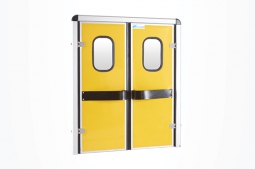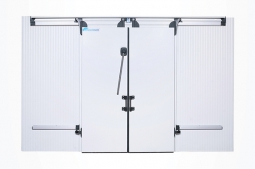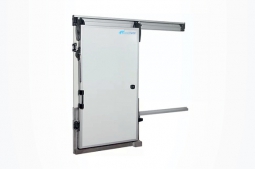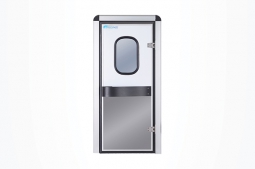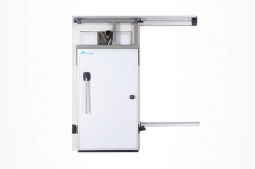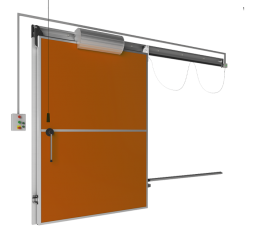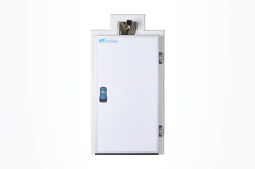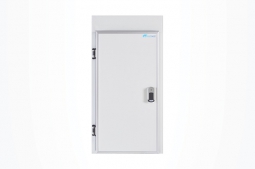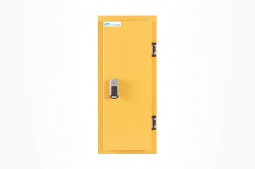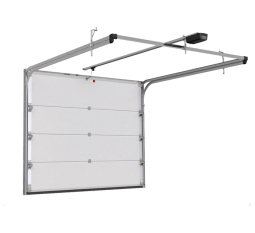





Sliding Freezer Door
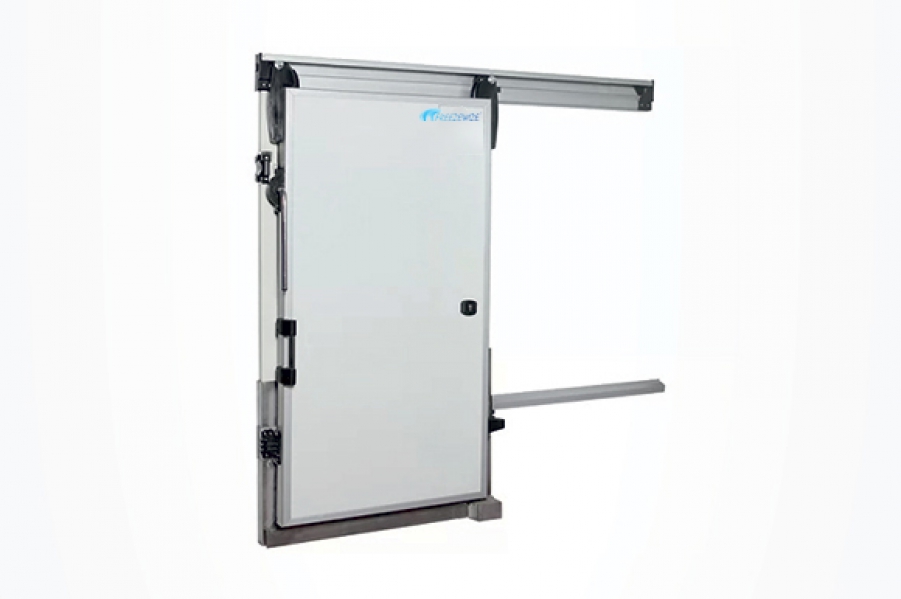
A sliding freezer door is an insulated low-temperature door designed for walk-in freezers, industrial freezer rooms, blast freezer facilities, frozen food warehouses, and temperature-controlled cold storage. Unlike a hinged freezer door, a freezer sliding door moves horizontally along the wall, keeping valuable floor space clear while providing wide access for personnel, pallets, carts, and material-handling operations.
Freezewize Cooling System manufactures each Sliding Freezer Door with high-density polyurethane insulation, reinforced sliding hardware, heated sealing, customizable thickness, plus manual or motorized operation. Designed for temperatures down to −40°C (−40°F), this insulated freezer door is built around thermal performance, reliable sealing, frost control, and practical industrial access.
Sliding Freezer Door Specifications
| Technical Feature | Freezewize Specification |
|---|---|
| Product Type | Sliding Freezer Door |
| Door Type | Horizontal insulated sliding door |
| Application | Cold room / Industrial freezer / Cold storage warehouse |
| Insulation Core | High-density polyurethane foam |
| PU Density | 40–45 kg/m³ |
| Thermal Conductivity | ≤ 0.022 W/m·K |
| 80 mm Thickness | R-20 |
| 100 mm Thickness | R-25 |
| 120 mm Thickness | R-30 |
| 150 mm Thickness | R-38 |
| U-Value at 150 mm | Approx. 0.15 W/m²K |
| Surface Options | Pre-coated galvanized steel / AISI 304 stainless steel |
| Sliding System | Reinforced top rail with heavy-duty rollers |
| Sealing System | Magnetic seal with heated frame and heated gasket |
| Frame Options | Insulated aluminum / stainless steel |
| Operating Range | +2°C to −40°C / 35.6°F to −40°F |
| Frost Protection | Heated threshold / optional anti-condensation system |
| Air Sealing | Industrial multi-point thermal sealing |
| Operation | Manual or motorized |
| Dimensions | Customized according to project |
Freezer Sliding Door Design
A freezer sliding door solves a different access problem than a conventional hinged door.
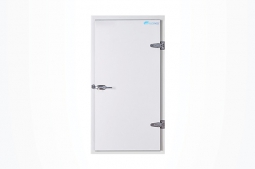
A hinged freezer door requires clear swing space in front of or behind the opening. A cold room sliding door moves parallel to the insulated wall, leaving the approach area available for pallets, carts, personnel, racks, or production equipment.
This becomes especially important in industrial cold storage facilities where every meter around a doorway affects material flow.
The horizontal sliding configuration also makes a Sliding Freezer Door practical for larger openings where a wide hinged leaf could become difficult to operate or interfere with surrounding equipment.
Typical applications include:
- Walk-in freezers
- Frozen food warehouses
- Industrial cold rooms
- Blast freezer facilities
- Meat cold storage
- Seafood freezing facilities
- Poultry storage
- Logistics warehouses
- Distribution centers
- Pharmaceutical cold storage
- Large freezer rooms
Low-Temperature Insulation
A sliding freezer door operates between two environments with a significant temperature difference. Insulation therefore becomes one of the most important parts of freezer door design.
Freezewize uses high-density polyurethane foam with a density of 40–45 kg/m³ and thermal conductivity of ≤ 0.022 W/m·K.
Door thickness can be selected according to operating conditions:
80 mm — R-20
Suitable for selected refrigerated and moderate low-temperature applications.
100 mm — R-25
Provides increased resistance for freezer environments.
120 mm — R-30
Suitable for more demanding industrial freezer conditions.
150 mm — R-38
Designed for high-performance low-temperature freezer applications.
At 150 mm thickness, specified U-value is approximately 0.15 W/m²K.
Using different insulation thicknesses allows a freezer sliding door to be matched with actual temperature requirements instead of applying one standard door construction to every project.
Heated Freezer Sealing
Low-temperature freezer entrances create an additional challenge: moisture and frost around sealing surfaces.
When warm, humid air reaches a cold freezer opening, condensation can develop. At sufficiently low surface temperatures, that moisture can freeze around frames, gaskets, or thresholds.
For this reason, Freezewize Sliding Freezer Door uses a magnetic sealing system combined with an integrated heated frame and heated gasket.
A heated threshold is also available, while an anti-condensation system can be evaluated according to project requirements.
These elements are particularly important in freezer rooms operating at strongly negative temperatures because a freezer door must remain both insulated and operational after repeated opening cycles.
Cold Room Sliding System
A cold room sliding door depends heavily on its mechanical system.
Unlike hinges that carry a rotating door leaf, sliding construction transfers door movement through a rail and roller arrangement.
Freezewize uses a reinforced top rail with heavy-duty rollers to support repeated horizontal movement.
A properly configured sliding system helps provide:
- Smooth opening
- Controlled door movement
- Reliable alignment
- Reduced operating effort
- Stable sealing after closure
- Practical access for wide openings
Rail condition and door alignment also affect sealing performance. A freezer door that does not return consistently to its correct closed position can compromise perimeter contact even when its insulation panel is technically strong.
For this reason, door hardware, track geometry, sealing, and insulation need to be evaluated as one system.
Sliding Versus Hinged
Choosing between a sliding freezer door and a hinged freezer door depends largely on traffic, available space, opening size, and operating pattern.
| Project Condition | Sliding Freezer Door | Hinged Freezer Door |
|---|---|---|
| Limited swing space | Strong choice | Requires clearance |
| Wide openings | Strong choice | More limited |
| Pallet movement | Highly suitable | Application dependent |
| Forklift approach | Highly suitable | Less practical |
| Small personnel opening | Suitable | Often practical |
| Frequent goods movement | Strong choice | Application dependent |
| Large industrial freezer | Strong choice | Possible |
| Simple small freezer | Possible | Often simpler |
A freezer sliding door becomes particularly valuable when access geometry or material movement makes a swinging leaf inconvenient.
A smaller walk-in freezer with occasional personnel access may still be better served by a hinged freezer door.
Door selection therefore needs to follow actual operation rather than assuming one door type is universally better.
Cold Storage Traffic
Industrial cold storage sliding doors often operate at busy transition points.
Frozen products may enter or leave on pallets. Workers may use pallet jacks or carts. Logistics facilities may move goods through the same freezer opening throughout multiple shifts.
In these conditions, entrance design affects more than convenience.
Door width, opening direction, rail location, surrounding clearance, sealing arrangement, and operating method all influence how efficiently goods pass through the freezer boundary.
A correctly sized Sliding Freezer Door helps create an access point that fits warehouse movement rather than forcing material flow around the door.
Manual or Motorized
Freezewize sliding freezer doors are available with manual or motorized operation.
Manual Sliding Operation
Manual operation is suitable where door size, opening frequency, and facility workflow allow straightforward hand operation.
It provides a simpler solution for freezer entrances that do not cycle continuously throughout each shift.
Motorized Sliding Operation
Motorized operation is useful for larger doors or higher-traffic cold storage applications where repeated manual opening could interrupt workflow.
Automation may also support facilities where forklifts, pallets, carts, or regular product transfers use the freezer entrance.
The correct choice depends on:
- Door dimensions
- Door weight
- Daily cycle frequency
- Traffic type
- Access speed
- Facility layout
- Operating requirements
Automation therefore needs to be selected around real use rather than treated only as an optional accessory.
Stainless Steel Surfaces
Surface material changes how an insulated freezer door performs in different working environments.
Freezewize offers:
Pre-Coated Galvanized Steel
Suitable for many standard commercial and industrial cold storage applications.
AISI 304 Stainless Steel
Suitable for hygiene-sensitive environments, frequent cleaning, moisture exposure, food processing, or applications requiring improved corrosion resistance.
Stainless steel becomes particularly relevant in meat, seafood, dairy, poultry, and food processing facilities where cleaning routines are more demanding.
Surface selection should therefore reflect facility conditions as well as appearance.
Freezer Door Applications
A Sliding Freezer Door can be integrated into different cold-chain environments.
Walk-In Freezers
Commercial or industrial rooms used for frozen product storage.
Frozen Food Warehouses
Large freezer areas handling palletized or bulk frozen products.
Meat Cold Storage
Frozen meat facilities requiring hygienic surfaces plus wide product access.
Seafood Freezers
Low-temperature rooms where moisture, cleaning, corrosion exposure, plus freezer performance require careful material selection.
Cold Chain Logistics
Distribution facilities with repeated pallet or product movement through freezer entrances.
Blast Freezer Areas
Applications operating at very low temperatures where insulation, frost prevention, plus sealing become especially important.
Each application requires different combinations of door thickness, surface material, opening size, sealing, hardware, and operating method.
Freezer Door Selection
Correct sliding freezer door specification starts with operating conditions.
Important project information includes:
Operating Temperature
A −18°C freezer and a −40°C application do not place identical demands on the door.
Opening Dimensions
Width and height influence door leaf size, rail requirements, plus operating method.
Traffic Type
Personnel, carts, pallet jacks, forklifts, or large products create different access requirements.
Opening Frequency
High-cycle entrances require greater attention to hardware and operation.
Insulation Thickness
Thermal resistance needs to correspond with room conditions.
Surface Material
Cleaning, humidity, hygiene, and corrosion exposure influence material choice.
Sealing Configuration
Freezer temperatures require strong perimeter sealing plus suitable frost-control measures.
Available Wall Space
A sliding door requires sufficient lateral travel area beside the opening.
Selecting these parameters before production allows the freezer sliding door to be engineered around the facility rather than selected only from nominal dimensions.
Custom Freezer Doors
Industrial freezer projects rarely share identical door requirements.
Freezewize Cooling System manufactures each Sliding Freezer Door according to project dimensions, room temperature, wall construction, traffic pattern, surface requirements, and operating conditions.
Custom configuration can include:
- Door dimensions
- Insulation thickness
- Galvanized or stainless steel surface
- Frame material
- Heated sealing
- Heated threshold
- Manual operation
- Motorized operation
- Project-specific installation details
This project-based approach allows the cold storage sliding door to work with insulated panels, refrigeration equipment, floor structure, and facility traffic as one coordinated system.
Complete Freezer Integration
Freezewize Cooling System supplies the Sliding Freezer Door as an individual product or integrates it into complete freezer and cold storage projects.
Turnkey project scope includes project design, cooling-load calculation, insulated cold room panels, cold room doors, industrial refrigeration systems, electrical controls, automation, installation, testing, commissioning, and final handover.
This allows freezer temperature, door thickness, sealing, refrigeration capacity, access dimensions, traffic frequency, plus installation conditions to be evaluated together.
For walk-in freezers, industrial freezer rooms, frozen food warehouses, or low-temperature cold storage projects, contact Freezewize Cooling System to specify a sliding freezer door suited to your operating temperature and access requirements.