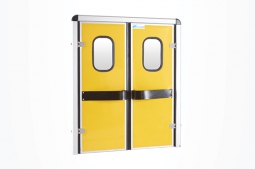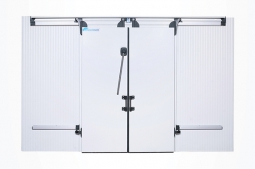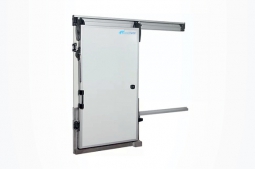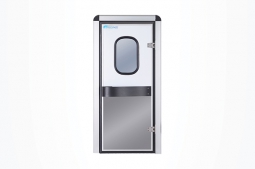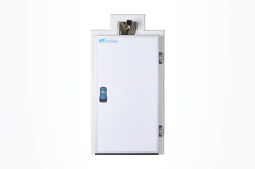





Monorail Sliding Cold Room Door
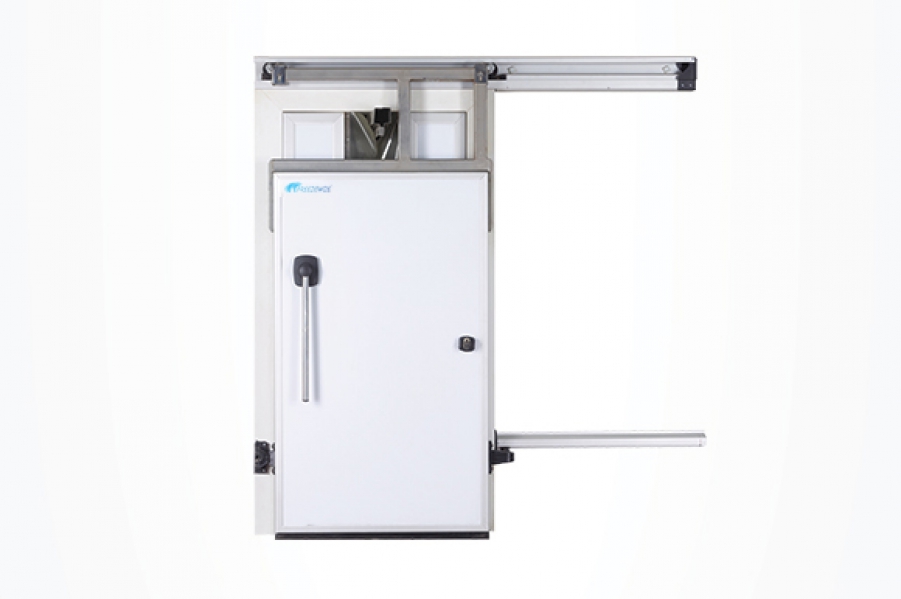
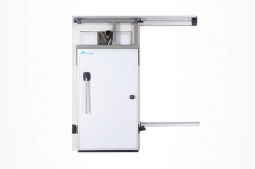
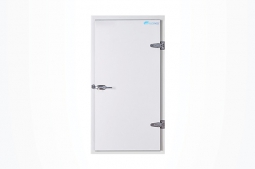
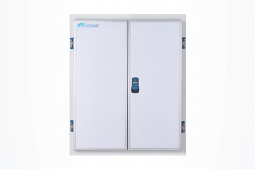
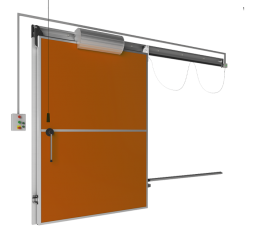
A monorail cold room door is a specialized insulated refrigerated door designed for facilities where an overhead meat rail or monorail conveyor must pass continuously through a cold room entrance. Freezewize Monorail Sliding Cold Room Door combines horizontal sliding movement with a precision-designed monorail passage, allowing suspended products to move between processing, chilling, and cold storage areas without interrupting the overhead rail system.
This monorail sliding door is particularly suited to red meat processing facilities, carcass chilling rooms, refrigerated production areas, meat cold storage, and other temperature-controlled operations using overhead rail transport. Its insulated polyurethane construction, thermal sealing around the monorail opening, heavy-duty sliding hardware, plus customizable rail geometry allow door and conveyor infrastructure to function as one coordinated cold room system.
Monorail Cold Room Door Specifications
| Technical Feature | Freezewize Specification |
|---|---|
| Product Type | Monorail Sliding Cold Room Door |
| Door Configuration | Horizontal sliding monorail door |
| Primary Application | Meat processing / Refrigerated production / Cold rooms |
| Rail Application | Overhead monorail conveyor passage |
| Insulation Core | High-density polyurethane foam |
| PU Density | 40–45 kg/m³ |
| Thermal Conductivity | ≤ 0.022 W/m·K |
| Door Thickness – 60 mm | R-15 |
| Door Thickness – 80 mm | R-20 |
| Door Thickness – 100 mm | R-25 |
| U-Value at 100 mm | Approx. 0.22 W/m²K |
| Surface Options | Pre-painted galvanized steel / AISI 304 stainless steel |
| Sliding System | Heavy-duty top rail with reinforced industrial rollers |
| Monorail Integration | Precision-cut rail passage with thermal sealing |
| Door Seal | Magnetic seal with flexible thermal sealing |
| Frame Construction | Insulated aluminum / stainless steel |
| Operating Range | +2°C to +10°C / 35.6°F to 50°F |
| Air Sealing | Industrial multi-point thermal sealing |
| Operation | Manual or motorized sliding |
| Production | Custom manufactured according to monorail dimensions |
Monorail Cold Room Door Design
A standard cold room door is designed around an uninterrupted rectangular opening. A monorail cold room door needs to solve an additional problem: an overhead rail must continue through that insulated boundary.
In meat handling facilities, carcasses or suspended products move along an overhead monorail between processing, chilling, storage, or dispatch zones. The rail cannot simply stop at each refrigerated doorway.
Freezewize designs the Monorail Sliding Cold Room Door around this operating requirement.
A dedicated opening is integrated into the upper door area so the overhead monorail can continue through the cold room entrance. Thermal sealing around this rail passage helps reduce the weak point that would otherwise be created where the conveyor crosses the insulated enclosure.
This makes monorail door design fundamentally different from simply cutting a conventional sliding door around a rail.
Meat Rail Door Access
A meat rail door needs to accommodate both the refrigerated enclosure and suspended product transport.
Typical product flow may include:
- Beef carcasses
- Lamb carcasses
- Sheep and goat products
- Hanging meat
- Meat processing loads
- Suspended food products
- Overhead conveyor hooks
- Carcass rail systems
The door opening, monorail position, rail height, door thickness, frame geometry, plus sliding direction therefore need to be considered together.
A poorly coordinated rail passage can create unnecessary gaps around the upper opening. Those gaps can increase uncontrolled air movement between refrigerated and ambient spaces.
A purpose-built monorail cold room door allows the passage geometry to be designed around actual rail dimensions rather than adapting the rail to a generic refrigerated door after installation.
Sliding Monorail Door Movement
A monorail sliding door moves horizontally alongside the cold room wall.
This gives it a different operating geometry from a monorail hinged door.
The sliding leaf does not require a large swing path in front of the opening. This can be useful in meat processing facilities where working space around the doorway is occupied by rail systems, product movement, personnel, equipment, or processing operations.
Horizontal movement also helps keep the access route in front of the cold room open.
A sliding configuration becomes especially relevant where:
- Wall space is available beside the opening
- Swing clearance is restricted
- Suspended products move frequently
- Cold room access needs to remain open during product transfer
- Processing equipment is positioned near the entrance
- Door operation needs to avoid interfering with workers or carcass movement
Carcass Rail Door Integration
A carcass rail door is not an isolated component.
Its position needs to correspond precisely with overhead transport infrastructure.
Important monorail dimensions include:
Rail Height
The vertical position of the rail relative to the cold room opening.
Rail Centerline
The exact horizontal location where the rail crosses the door.
Hook Clearance
Space required for hooks, carriers, or suspended products.
Product Clearance
Required width and height for carcasses or suspended loads.
Door Travel Direction
Available wall space for sliding movement.
Upper Sealing Geometry
How insulation and sealing continue around the monorail penetration.
Freezewize manufactures each Monorail Sliding Cold Room Door according to actual project and monorail dimensions.
This custom approach is particularly important because small alignment errors at the upper rail passage can affect both conveyor movement and door sealing.
Insulated Monorail Door
A cold storage monorail door still forms part of the insulated cold room envelope.
Freezewize uses high-density polyurethane foam with a density of 40–45 kg/m³ and thermal conductivity of ≤ 0.022 W/m·K.
Available insulation thicknesses include:
60 mm — R-15
Suitable for selected positive-temperature refrigerated applications.
80 mm — R-20
Provides increased thermal resistance for chilled cold rooms and meat processing applications.
100 mm — R-25
Offers higher insulation performance where stronger thermal separation is required.
At 100 mm thickness, specified U-value is approximately 0.22 W/m²K.
Correct thickness selection needs to consider room temperature, ambient conditions, operating schedule, panel construction, opening frequency, plus product flow.
Monorail Thermal Sealing
The most critical area of a monorail cold room door is often not the center of the insulated door leaf.
It is the point where the overhead rail passes through the refrigerated boundary.
Freezewize uses a precision-cut monorail guide with thermal sealing around this transition.
The door also uses magnetic and flexible thermal sealing around its perimeter.
These sealing details help reduce uncontrolled air passage after the monorail sliding door closes.
This matters because repeated air infiltration around a refrigerated entrance can contribute to:
- Temperature variation
- Condensation
- Higher refrigeration demand
- Moisture around door surfaces
- Reduced cold room stability
Monorail door performance therefore depends on both the insulated leaf and the quality of the rail transition.
Meat Processing Applications
The Monorail Sliding Cold Room Door is particularly relevant to cold storage systems serving red meat operations.
Carcass Chilling Rooms
After processing, carcasses may move on overhead rail systems into temperature-controlled chilling areas.
A carcass rail door allows the conveyor route to continue through the refrigerated boundary.
Chilled Meat Storage
Suspended meat may remain on rail systems while moving between processing and refrigerated storage zones.
Meat Processing Areas
Processing layouts may include several temperature-controlled rooms connected by a common monorail network.
Cutting and Preparation Areas
Overhead transport may continue between chilled storage and downstream working areas.
Cold Storage Facilities
Industrial meat storage projects may use rail systems for efficient suspended product handling.
Refrigerated Dispatch Zones
Monorail systems may also form part of controlled movement toward further processing or distribution.
Freezewize supplies the refrigerated door and cold storage infrastructure around these applications without implying supply of slaughterhouse or meat-processing machinery itself.
Stainless Steel Monorail Door
Meat processing environments often place strong demands on surface hygiene.
Freezewize offers AISI 304 stainless steel as a surface option for the Monorail Sliding Cold Room Door.
Stainless steel is particularly relevant where the door is exposed to:
- Repeated cleaning
- Moisture
- Food processing environments
- Hygiene-sensitive operations
- Corrosion risk
Pre-painted galvanized steel is also available for standard refrigerated applications.
Material selection should follow the actual cleaning regime, room use, humidity, plus facility specification.
Heavy-Duty Sliding System
The mechanical movement of a monorail sliding door is handled through a heavy-duty top rail with reinforced industrial rollers.
This sliding hardware needs to carry the insulated door leaf while maintaining consistent horizontal alignment.
Correct alignment is important because door movement influences:
- Closing position
- Gasket contact
- Monorail passage alignment
- Operating force
- Long-term wear
A sliding door that does not return correctly to its designed position may create uneven sealing even when insulation quality remains unchanged.
For this reason, rail hardware and insulated door construction need to be specified as one system.
Manual or Motorized Operation
Freezewize Monorail Sliding Cold Room Door can be configured for manual or motorized movement.
Manual Monorail Sliding Door
Manual operation can suit entrances where door dimensions and operating frequency allow straightforward hand movement.
Motorized Monorail Sliding Door
Motorized movement becomes more relevant where:
- Door dimensions are larger
- Product flow is frequent
- Operational cycles are high
- Manual door handling would slow production
- Process coordination benefits from controlled door movement
Automation selection should be based on real operating frequency and production flow.
Monorail Sliding vs Hinged
Freezewize offers both sliding and hinged monorail door configurations because facility layout changes which system is more appropriate.
| Project Requirement | Monorail Sliding Door | Monorail Hinged Door |
|---|---|---|
| Overhead rail passage | Yes | Yes |
| Horizontal wall space available | Required | Less important |
| Swing clearance limited | Strong choice | Requires clearance |
| Busy processing area | Strong application | Application dependent |
| Simple hinged operation preferred | Possible | Strong choice |
| Equipment near doorway | Often advantageous | Layout dependent |
| Sliding movement preferred | Yes | No |
| Carcass rail integration | Yes | Yes |
Neither door type is automatically better.
The correct monorail cold room door depends on wall space, rail location, traffic pattern, processing layout, door size, plus operating preference.
Monorail Door Selection
Specifying a Monorail Sliding Cold Room Door starts with the rail system rather than only the wall opening.
Important project information includes:
Cold Room Temperature
Room temperature influences insulation thickness and sealing requirements.
Door Dimensions
Clear opening width and height need to accommodate product movement.
Monorail Dimensions
Rail height, rail profile, centerline, hanger geometry, plus clearance need to be supplied accurately.
Product Type
Beef, lamb, goat, or other suspended products create different clearance requirements.
Traffic Frequency
Repeated product movement influences hardware and operation selection.
Available Wall Space
A sliding door needs enough lateral space beside the opening.
Surface Requirement
Food processing conditions may favor stainless steel.
Manual or Motorized Operation
Cycle frequency and door size influence operating method.
Collecting this information before manufacture allows the cold storage monorail door to match both the insulated room and overhead transportation system.
Cold Room System Integration
A monorail entrance interacts with more than the door itself.
Freezewize Cooling System can coordinate the monorail cold room door with:
- Cold room wall panels
- Ceiling panels
- Refrigeration systems
- Electrical control systems
- Cold room layout
- Door automation
- Installation details
This becomes particularly important in meat processing projects because rail position, ceiling height, panel joints, door opening, plus refrigeration layout need to coexist within the same facility.
Custom Monorail Sliding Door
No two overhead rail layouts are necessarily identical.
Freezewize therefore manufactures each Monorail Sliding Cold Room Door according to project dimensions.
Custom configuration can include:
- Opening width
- Opening height
- Door thickness
- Monorail height
- Rail passage dimensions
- Sliding direction
- Surface material
- Frame material
- Manual or motorized operation
- Sealing details
- Installation conditions
This allows the monorail sliding door to be designed around the facility instead of forcing an existing monorail system to adapt to a standard door.
Turnkey Meat Cold Storage Integration
Freezewize Cooling System supplies the Monorail Sliding Cold Room Door as an individual refrigerated product or integrates it into a complete cold storage project.
Our turnkey scope includes project design, cooling-load calculation, insulated cold room panels, cold room doors, industrial refrigeration systems, electrical control and automation systems, installation, testing, commissioning, and final handover.
For red meat processing facilities, this allows room temperature, monorail position, door geometry, insulation, refrigeration capacity, automation, plus installation requirements to be coordinated during project design.
For a carcass chilling room, meat processing cold room, refrigerated production area, or overhead rail cold storage project, contact Freezewize Cooling System to specify a monorail cold room door designed around your rail system and operating conditions.