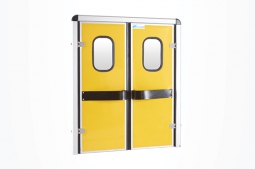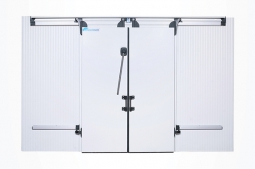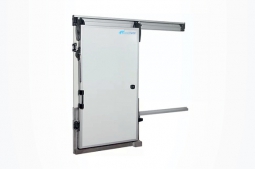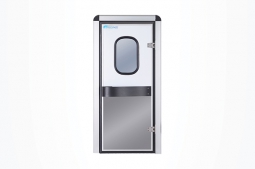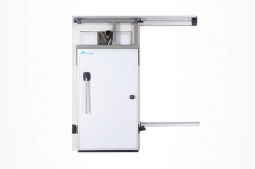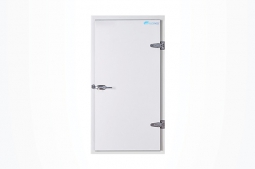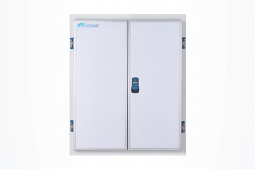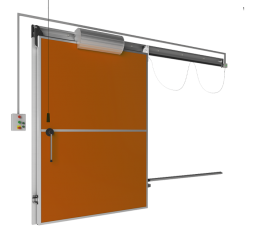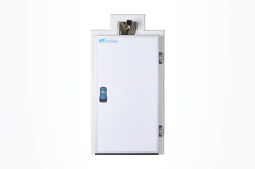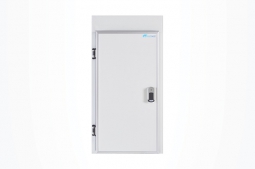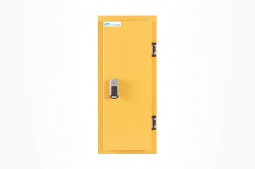





Hinged Freezer Door
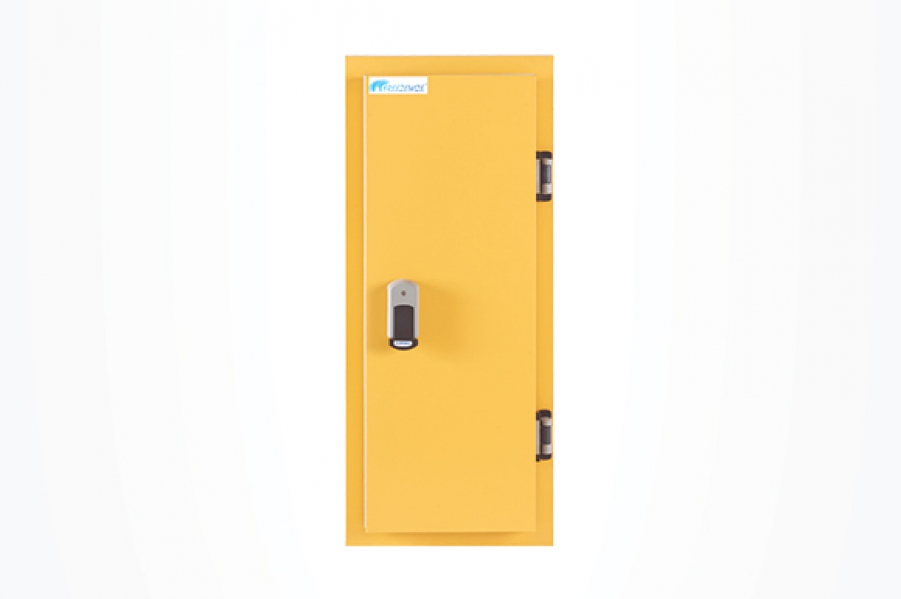
A hinged freezer door is an insulated low-temperature door designed for walk-in freezers, frozen food storage, industrial freezer rooms, cold chain facilities, food processing plants, plus other sub-zero cold storage applications. Freezewize Hinged Freezer Door combines high-density polyurethane insulation, reinforced door construction, multi-point magnetic sealing, adjustable industrial hinges, plus heated frame and threshold options for freezer environments reaching −40°C (−40°F).
Freezer access requires more than a thick insulated door leaf. Frame temperature, gasket pressure, hinge alignment, threshold condition, moisture exposure, opening frequency, plus room pressure all influence daily performance. Freezewize Cooling System designs each hinged freezer door around actual freezer temperature, opening dimensions, cold room panel structure, traffic pattern, surface requirement, and installation conditions.
Hinged Freezer Door Specifications
| Technical Feature | Freezewize Specification |
|---|---|
| Product Type | Hinged Freezer Door |
| Door Configuration | Insulated single-leaf hinged freezer door |
| Primary Application | Walk-In Freezer / Industrial Freezer / Frozen Cold Storage |
| Operating Temperature | Down to −40°C / −40°F |
| Insulation Core | High-density polyurethane foam |
| Door Thickness | Project-specific, up to 120 mm |
| Door Structure | Reinforced insulated freezer door leaf |
| Sealing System | Multi-point magnetic sealing |
| Hinge System | Heavy-duty adjustable hinged mechanism |
| Low-Temperature Protection | Heated frame available |
| Threshold Protection | Heated threshold option |
| Surface Construction | Corrosion-resistant materials |
| Installation | Integration with modular cold room panels |
| Manufacturing | Customized according to project dimensions |
Freezer Door Insulation
A freezer door forms one of the most frequently interrupted points in a low-temperature enclosure.
Cold room panels remain closed continuously. A door opens, moves, closes, carries hardware, includes seals, and connects internal freezer conditions directly with ambient air during each access cycle.
For this reason, freezer door insulation needs to work together with:
- Door thickness
- Frame insulation
- Gasket compression
- Threshold construction
- Panel thickness
- Room temperature
- Ambient conditions
- Opening frequency
Freezewize uses a high-density polyurethane insulated core inside Hinged Freezer Door construction.
Insulation reduces conductive heat transfer through the closed door leaf, but door thickness alone does not guarantee strong freezer performance.
A 120 mm insulated door with poor gasket contact can perform worse operationally than a correctly installed door with consistent perimeter sealing.
Freezer door specification therefore starts with complete opening behavior rather than one insulation number.
Sub-Zero Door Sealing
Reliable sealing becomes increasingly important as temperature difference increases.
A hinged freezer door separating a −18°C, −25°C, or lower-temperature room from a warmer surrounding area faces continuous pressure from heat and moisture movement.
Freezewize uses multi-point magnetic sealing to create perimeter contact after door closure.
Important sealing zones include:
- Hinge side
- Handle side
- Door head
- Lower edge
- Upper corners
- Lower corners
- Threshold interface
A small localized gap may look insignificant when a freezer is empty or recently installed.
During normal operation, repeated air infiltration through that same point can produce visible frost, moisture, or ice patterns.
This makes gasket condition a useful diagnostic indicator.
Frost concentrated around one corner often indicates a local alignment or seal-contact problem rather than insufficient insulation across the complete door.
Heated Freezer Frame
Frame heating addresses one of the most common low-temperature door problems: extremely cold perimeter surfaces meeting warmer humid air.
When moisture reaches a cold frame, condensation may develop. At sub-zero temperatures, condensation can freeze.
Freezewize offers a heated frame configuration for demanding freezer applications.
Frame heating helps support:
- Gasket flexibility
- Cleaner perimeter contact
- Reduced freezing around frame edges
- Easier opening
- Reduced ice accumulation
- More predictable daily access
Heating is not a replacement for proper sealing.
A damaged gasket, misaligned hinge, warped frame, or oversized installation gap still needs mechanical correction.
Heated frame design works most effectively when door geometry and sealing already function correctly.
Heated Threshold Control
Lower door areas face a different challenge.
Cold air naturally settles near floor level while cleaning water, floor moisture, condensation, or ambient humidity can collect around a freezer entrance.
A heated threshold option helps manage icing risk around this critical transition.
Threshold planning needs to consider:
- Freezer floor insulation
- Finished floor elevation
- Drainage
- Cart movement
- Cleaning routines
- Ambient humidity
- Door traffic
- Freezer temperature
- Gasket contact
Threshold heating becomes particularly important where ice formation could restrict door movement or create an unsafe walking surface.
Correct floor detail should be planned before door installation rather than treated as a later accessory decision.
Frost Pattern Diagnosis
Frost around a walk-in freezer door contains useful information.
Different frost patterns can point toward different operating problems.
Frost at Corners
Possible causes include uneven gasket compression or door-leaf alignment.
Frost Along Hinge Side
Hinge position, door sag, or incomplete gasket contact deserves inspection.
Frost Near Threshold
Floor moisture, insufficient lower sealing, frequent traffic, or threshold temperature may be contributing factors.
Frost Across Frame
Warm humid ambient air may be interacting with cold frame surfaces.
Heavy Interior Frost
High opening frequency, long open periods, pressure difference, or general air infiltration may be involved.
Simply removing ice does not identify its source.
A strong freezer maintenance process looks for where frost returns, how quickly it returns, and which part of door geometry corresponds with that pattern.
This type of observation can reveal operational issues before door movement becomes difficult.
Hinge Alignment Control
A hinged freezer door carries its complete insulated leaf on one side.
As door dimensions or insulation thickness increase, hinge loading also increases.
Freezewize uses a heavy-duty adjustable hinged mechanism to maintain stable movement plus accurate closing position.
Hinge alignment affects:
- Door height
- Gasket pressure
- Handle-side contact
- Threshold clearance
- Closing force
- Frame alignment
- Long-term seal wear
A door leaf that drops only a few millimeters can change gasket contact across multiple edges.
This explains why replacing a freezer gasket does not always solve an air-leakage problem.
If root cause is hinge position, new sealing material will eventually reproduce the same uneven contact.
Freezer door maintenance should therefore evaluate hinge alignment before assuming gasket failure.
Walk-In Freezer Access
A walk-in freezer door often serves a very different traffic profile from a large warehouse sliding entrance.
Common movement includes:
- Personnel
- Hand carts
- Small product racks
- Ingredient containers
- Picking operations
- Stock replenishment
- Cleaning equipment
- Routine inspection
Hinged construction provides direct access without requiring lateral wall space for sliding movement.
This makes a hinged freezer door especially practical where:
- Opening size is moderate
- Personnel access dominates
- Wall space is limited
- Simple manual operation is preferred
- Swing clearance is available
- Large forklift traffic is not primary use
Door type should follow traffic rather than habit.
A hinged door is not automatically correct for every freezer, just as a sliding door is not automatically better.
Hinged vs Sliding
Hinged and sliding freezer doors solve different access problems.
| Project Requirement | Hinged Freezer Door | Sliding Freezer Door |
|---|---|---|
| Personnel access | Strongchoice | Suitable |
| Moderate opening | Strongchoice | Suitable |
| Large pallet opening | Application dependent | Strongchoice |
| Forklift access | Limited by layout | Strongchoice |
| Wall travel space | Not required | Required |
| Swing clearance | Required | Not required |
| Simple manual movement | Strongchoice | Suitable |
| Heavy industrial traffic | Application dependent | Oftenstronger |
| Compact freezer | Strongchoice | Layout dependent |
| Large warehouse freezer | Possible | Often preferred |
A hinged freezer door works particularly well when access remains compact, manual, plus personnel-oriented.
A sliding freezer door becomes more suitable as opening size, pallet traffic, or forklift movement increases.
This distinction also keeps both Freezewize product pages focused on separate buyer intentions.
Freezer vs Cooler
Freezer and cooler hinged doors may appear similar from outside, but operating conditions are not the same.
Hinged Cold Room Door
Primary environment:
- Positive-temperature storage
- Walk-in coolers
- Chilled food rooms
- Fresh product storage
- Food preparation areas
Hinged Freezer Door
Primary environment:
- Negative-temperature rooms
- Frozen storage
- Walk-in freezers
- Deep-freeze applications
- Low-temperature cold chain
Sub-zero conditions create stronger requirements around:
- Frost
- Condensation
- Perimeter temperature
- Threshold icing
- Gasket behavior
- Frame heating
- Insulation
- Door alignment
For this reason, Freezewize treats Hinged Freezer Door as a separate product rather than simply offering a cooler door with a different label.
Opening Time Exposure
One of the largest sources of freezer-door heat gain occurs while door opening is physically exposed.
No insulation works across an open doorway.
For this reason, opening duration matters alongside insulation performance.
Consider two operating patterns:
Operation A
Staff prepare load outside freezer, open door, enter, clear opening, close immediately.
Operation B
Staff open door first, search for a cart, prepare products, communicate with coworkers, then close after several minutes.
Same freezer door. Same insulation.
Very different exposure.
Effective freezer operations reduce unnecessary open time through:
- Prepared loads
- Clear access routes
- Defined picking procedures
- Unblocked swing zones
- Correct door sizing
- Staff workflow
- Suitable traffic-door selection
Door engineering plus operating discipline work together.
Freezer Pressure Effects
Low-temperature rooms can experience pressure differences during refrigeration cycles, defrost events, or rapid temperature changes.
Pressure imbalance may affect door opening effort.
A user noticing that a freezer room door suddenly becomes difficult to open should not automatically assume hinge failure.
Possible factors include:
- Pressure difference
- Ice around gasket
- Frozen threshold
- Incorrect latch adjustment
- Door misalignment
- Seal adhesion
Project evaluation should consider complete freezer conditions before changing hardware.
This prevents replacing mechanical components when root cause sits elsewhere in room operation.
Door Surface Protection
A freezer door surface needs to handle more than temperature.
Daily operation may expose door leaves to:
- Cart contact
- Product containers
- Cleaning chemicals
- Moisture
- Condensation
- Food-processing environments
- Warehouse handling
Freezewize uses corrosion-resistant structural materials suited to demanding freezer applications.
Surface specification should consider real environment:
Food Processing
Frequent cleaning plus hygiene requirements become important.
Seafood Storage
Moisture and corrosion exposure deserve greater attention.
Frozen Warehouses
Cart or pallet handling may increase impact exposure.
Pharmaceutical Freezers
Cleanability, controlled access, plus consistent operation become key project considerations.
Door finish needs to reflect operation rather than only appearance.
Frozen Food Storage
A hinged freezer door serves many frozen-food applications.
Examples include:
Meat Freezers
Frozen beef, poultry, lamb, processed meat, plus packaged products.
Seafood Freezers
Fish, shrimp, shellfish, plus frozen seafood products.
Bakery Freezers
Frozen dough, finished bakery products, desserts, plus ingredients.
Prepared Food
Ready meals, packaged frozen products, plus production ingredients.
Dairy Freezers
Selected frozen dairy products or ingredients.
Cold Chain Storage
Frozen inventory waiting for distribution or transport.
Each application creates different traffic, hygiene, packaging, plus room-temperature requirements.
Door selection needs to follow actual storage and handling process.
Freezer Traffic Planning
Traffic frequency affects both hardware life and refrigeration performance.
Before selecting a freezer door, estimate:
- Openings per hour
- Peak traffic periods
- Number of employees
- Cart dimensions
- Product load size
- Average opening duration
- Cleaning frequency
- Shift pattern
A personnel freezer opened five times each hour has different requirements from a dispatch freezer opened repeatedly during an intensive loading period.
As traffic rises, another door type may become more appropriate.
High-frequency material movement may justify:
- Sliding freezer door
- Automatic sliding cold room door
- Wider access
- Different traffic routing
Choosing a hinged freezer door simply because it costs less initially can create operational inconvenience if traffic pattern does not suit swing access.
Swing Clearance Planning
A hinged door needs clear floor space.
Opening geometry should consider:
- Door width
- Swing direction
- Nearby racks
- Walls
- Evaporator location
- Product staging
- Cart routes
- Personnel paths
- Emergency access
A walk-in freezer door positioned too close to shelving can reduce useful opening angle.
A door swinging directly into a main traffic route can create repeated workflow conflict.
Swing direction should be determined during room planning, not after cold room panels are already installed.
Door Size Selection
Opening dimensions need to follow largest object expected to pass through.
Measure more than product width.
Consider:
- Cart width
- Cart handles
- Rack width
- Packaging projection
- Operator hand clearance
- Door frame clearance
- Turning radius
Oversizing also has consequences.
A much larger freezer opening increases:
- Door leaf weight
- Swing area
- Air exchange during opening
- Hinge load
- Gasket perimeter
- Installation demand
Correct sizing aims for enough access without unnecessary opening area.
Gasket Inspection
Freezer gaskets experience repeated compression plus low-temperature exposure.
Routine inspection should look for:
- Flattened sections
- Tears
- Hardening
- Loose corners
- Ice lines
- Missing contact marks
- Deformation
- Contamination
A useful inspection method is to compare gasket condition with visible frost patterns.
If frost repeatedly appears in one location, inspect corresponding gasket plus hinge geometry.
Do not assume every sealing problem requires complete gasket replacement.
Cleaning, adjustment, hinge correction, or localized service may solve root cause more effectively.
Threshold Inspection
Lower door areas often receive less attention than hinges or handles.
Yet threshold problems can directly affect freezer access.
Check for:
- Ice accumulation
- Damaged floor edges
- Water
- Uneven finished floor
- Gasket drag
- Heated threshold operation
- Cart impact
- Debris
Repeated contact between door leaf and floor can damage both sealing and hinge alignment over time.
Freezer entrance maintenance should therefore include floor condition as part of door inspection.
Hinged Door Maintenance
A hinged freezer door benefits from simple, consistent inspection.
Focus on:
Hinges
Check alignment, fasteners, movement, plus door-leaf level.
Seals
Inspect perimeter contact, frost marks, cracks, plus flexibility.
Frame
Check physical damage, moisture, ice, plus heated sections.
Threshold
Inspect frost, floor transition, plus lower seal contact.
Door Leaf
Look for impact damage, surface wear, edge damage, or deformation.
Closing Behavior
Door should reach its intended sealing position consistently.
Small changes detected early are easier to correct than a door that eventually becomes difficult to operate.
Retrofit Freezer Doors
Replacing an existing freezer door requires more than ordering the same nominal width.
Existing rooms may have:
- Different panel thickness
- Non-square openings
- Uneven floors
- Damaged frame areas
- Modified thresholds
- Older heating systems
- Limited swing space
Before manufacturing a replacement cold room freezer door, measure:
- Structural opening
- Clear opening
- Wall panel thickness
- Finished floor level
- Frame depth
- Opening squareness
- Existing heating connections
- Swing direction
- Surrounding obstacles
Correct retrofit measurement reduces site modification plus installation risk.
Hinged Freezer Door Selection
A strong hinged freezer door specification starts with operational information.
Freezer Temperature
Determine normal setpoint plus lowest expected operating condition.
Opening Dimensions
Measure both structural opening and required clear passage.
Panel Thickness
Door frame needs to integrate with insulated wall construction.
Traffic Type
Personnel, carts, racks, or mixed traffic affect door size plus hinge requirements.
Opening Frequency
Higher cycle counts increase mechanical and thermal demand.
Ambient Conditions
Humidity plus surrounding temperature influence condensation and frost risk.
Floor Structure
Threshold configuration needs to match freezer floor insulation.
Heating Requirement
Determine whether heated frame or threshold protection is needed.
Surface Environment
Cleaning, moisture, food production, plus corrosion exposure affect material choice.
Swing Clearance
Verify usable floor space before finalizing hinged configuration.
These details help Freezewize specify a door around actual freezer operation rather than a generic opening size.
Custom Freezer Door
Freezewize Cooling System manufactures each Hinged Freezer Door according to project requirements.
Custom configuration can address:
- Opening width
- Opening height
- Door thickness
- Cold room panel thickness
- Freezer temperature
- Frame configuration
- Heated frame
- Heated threshold
- Surface requirement
- Opening direction
- Hinge arrangement
- Sealing details
- Floor transition
- Installation conditions
Project-based manufacturing allows door structure to match freezer enclosure plus daily operating behavior.
Complete Freezer Integration
A freezer door performs best when refrigeration, insulated enclosure, flooring, plus access design are considered together.
Freezewize Cooling System supplies the Hinged Freezer Door individually or as part of a complete cold storage project.
Turnkey scope includes:
- Project design
- Cooling-load calculation
- Insulated cold room panels
- Cold room doors
- Industrial refrigeration systems
- Electrical control systems
- Automation
- Installation
- Testing
- Commissioning
- Final handover
This integrated approach allows freezer temperature, door dimensions, panel insulation, threshold heating, refrigeration capacity, traffic pattern, plus installation details to be coordinated during project design.
For walk-in freezers, frozen food rooms, meat storage, seafood freezers, pharmaceutical freezing rooms, cold chain facilities, or other sub-zero applications, contact Freezewize Cooling System to specify a
hinged freezer door
around your temperature, opening, traffic, and operating conditions.