




Sliding Openings for Monorail Workflow
Monorail Sliding Refrigerator Door for Monorail Workflow Efficiency
Keep your monorail workflow running smoothly with a sliding refrigerator door designed for overhead loading paths, cleaner openings, lower friction, and more reliable daily access.
Sliding Openings for Monorail Workflow
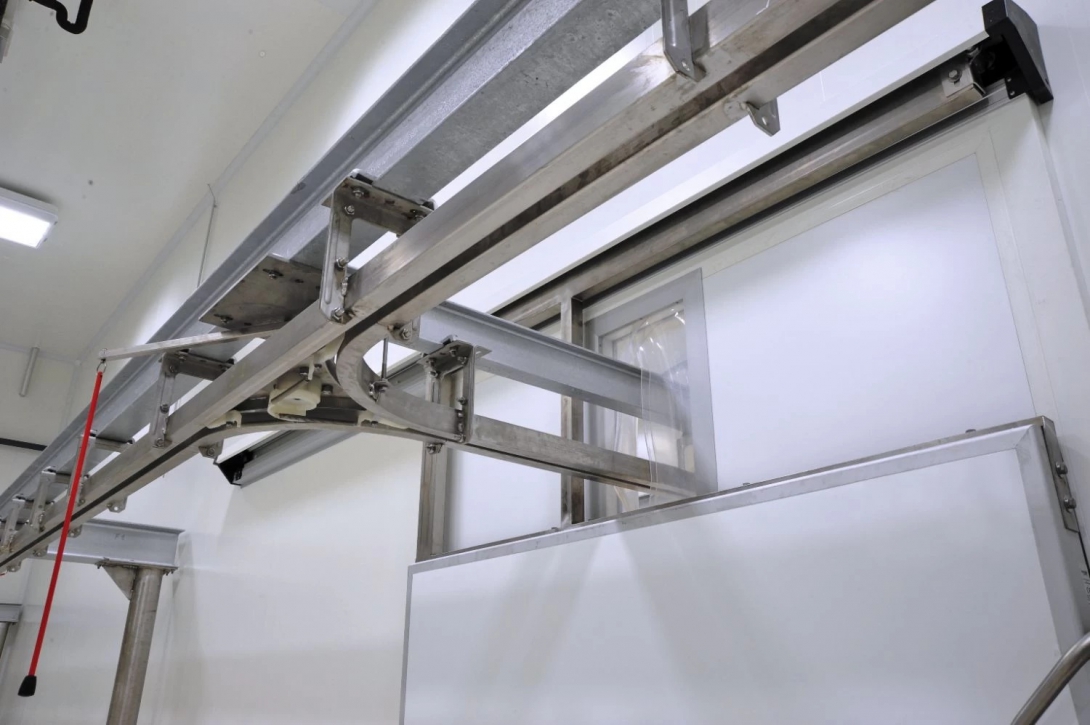
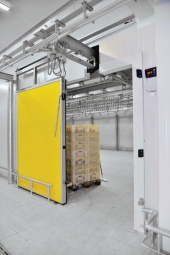
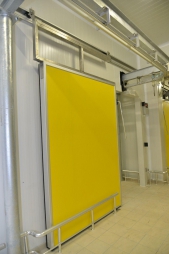
A monorail sliding cooler door is the right solution when you need to support top-down product movement without disrupting temperature control, workflow, or hygiene routines in the cooler opening. In monorail-driven facilities, an opening is not just an entry point. It becomes part of the process, and the wrong door choice can slow down movement, increase wear and tear, and complicate the management of the entire access point.
Therefore, sliding openings for monorail workflows must be planned according to how the room actually operates. The best result is not just a door that opens. It is an opening that clears the load path, protects the insulated shell, reduces daily friction, and maintains reliability during repeated operational use.
The Opening Becomes Part of the Workflow
In a standard cold storage room, the door typically serves a simple purpose: to help maintain the room’s temperature while allowing people, vehicles, or light equipment to move in and out. When the monorail comes into play, this logic changes.
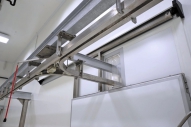
Now, the opening must work in harmony with overhead systems. Products may pass overhead continuously or semi-continuously. Personnel may be working around the opening as loads pass through it. Cleaning crews may now require access to an area that includes both the door hardware and monorail coordination points. Maintenance crews may need to maintain the opening’s alignment without disrupting the surrounding process.
This changes the purchasing decision. The question is no longer whether a door can shut out the cold. The question is whether the opening can support actual monorail workflow without becoming a point of delay, damage, or compromise.
The Point Where Operations Start to Feel the Friction
Pressure usually emerges first through small signs. Movement slows near the opening. Operators become more cautious around suspended loads. Entry no longer feels natural. Loads can pass through the area, but not smoothly. Staff begin to compensate for the opening rather than relying on it.
This type of friction is more significant than it appears. In food production, cold processing, specialized storage, and refrigerated transfer zones, small inefficiencies repeat throughout the day. A few extra seconds per pass can, over time, translate into a loss of labor efficiency. A few irregular points—such as edges, panels, hardware, or sealing areas—can create more impact than the original specifications intended.
In some facilities, the entrance also affects visual standards. Back-side clearances that appear prematurely worn or feel cumbersome in use may indicate a mismatch between the facility’s operational standards and the installed access solution.
Why Might the Wrong Door Still Seem Acceptable at First?
One of the most common issues with monorail openings is that the wrong choice can still appear functional. The door may open and close. The room may still maintain its temperature. On paper, the project may appear complete.
However, operationally, the opening may already be underperforming.
A general-purpose access approach often fails because it is chosen for basic door use rather than suspended product movement. This gap leads to issues that do not always surface during installation. These issues emerge later during actual production hours when traffic frequency, hygiene requirements, and the incompatibility of repeated use begin to reveal themselves.
It is at this point that buyers begin to see the true cost of an unsuitable solution:
slower workflow around the opening
greater maintenance requirements over time
more noticeable wear at a critical access point
more difficult cleaning around the interface
pressure to replace sooner than expected
a growing sense that the opening has never been fully resolved
A technically functional door is not always the right door. In a monorail workflow, suitability is more important than superficial functionality.
Why Does Sliding Logic Work Better in Monorail Conditions?
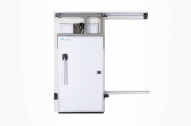
A monorail opening must protect the opening without creating unnecessary obstacles and support repetitive movement. For this reason, a sliding cooling door is generally more logical than a door format that is attached to the opening area or creates more obstacles near the path of movement.
The advantage is not just the sliding motion itself. The greater benefit is that the opening can be configured according to the operational workflow. When the access solution accounts for the overhead path, moving around the room, performing maintenance, and managing daily operations under pressure becomes easier.
This is particularly important in facilities where the opening serves the following functions:
suspended product transfer between cold zones
frequent overhead traffic tied to production flow
food processing or manufacturing operations with strict cleanliness requirements
refrigerated areas where floor traffic and overhead movement occur simultaneously
openings that must remain reliable under repeated daily use
Under these conditions, the door is no longer a passive building detail. It is part of the operational system.
Important Comparison for Buyers
The most useful comparison for monorail applications is not based solely on the door category. It should be based on whether the opening facilitates the workflow or requires the workflow to adapt to it.
Opening type | Best fit | Common issue in monorail workflow |
|---|---|---|
| Standard hinged cooler entry | Light staff access and routine non-specialized entry | Swing area can interfere with access and movement logic |
| Conventional sliding cooler opening | Larger cooler entries without specialized overhead coordination | May not fully address the monorail condition |
| Monorail sliding cooler door | Openings that must support overhead suspended movement | Requires correct integration with the full opening design |
Opening Type Best Use Common Issues in Monoray Workflow
Standard hinged cold room entrance Light personnel access and routine, non-specialized entries Swing area may obstruct access and movement logic
Traditional sliding cold room opening Larger cold room entrances that do not require special ceiling coordination May not fully meet Monoray requirements
Monorail sliding cold room door Openings that must support ceiling-suspended movement Requires proper integration with a full-opening design
This comparison is important because many projects are defined with a very broad scope. A door selected for general cold room access may be entirely reasonable in one area of a facility but completely inappropriate in another. The monorail workflow changes the standard.
What the Right Solution Must Actually Provide
A good monorail opening must do more than just create a passageway. It must support workflow without becoming a weak point that leads to heavy maintenance burdens or hygiene concerns.
This means the right solution must assist multiple operational goals simultaneously. It must maintain consistent access, support a more controlled passage condition, reduce unnecessary interference, and align with the room’s long-term usage model. Additionally, it must make practical sense for the surrounding environment, including adjacent insulated panels, gaskets, hardware, visibility requirements, and protective details around the entrance.
This is where project experience makes a difference. The Freezewize Cooling System treats monorail openings not merely as isolated door installations, but as an integral part of the refrigerated workflow. This approach enables better decision-making because the door, opening, and movement pattern are evaluated together.
Quick Decision Guide
A monorail sliding refrigerated door is generally a better choice when the opening is directly connected to overhead product flow and the facility requires a door entry that supports movement without creating an operational obstacle.
It is particularly suitable in the following situations:
if suspended loads frequently pass through the opening
if the entrance is part of a processing or transfer sequence
if the swing area poses an obstruction
if cleaning and food safety routines are critical in the opening
if the facility seeks not only basic short-term functionality but also reduced friction over time
if the customer aims to prevent premature wear and replacement pressure
If the entrance primarily serves personnel traffic and overhead conditions do not dictate how the area operates, a more general opening may still be acceptable. However, if a single-rail workflow defines the room, the opening must be selected accordingly.
Related Solutions
A single-lane workflow is rarely solved by a door alone. Buyers typically achieve better performance when the surrounding clearance conditions are planned as a complete access zone. Related solutions may include:
insulated panels for refrigerators and freezers for opening continuity
sliding cold storage doors for adjacent openings with similar traffic demands
protective hardware and impact guards for high-contact areas
viewing panels and access hardware for safer movement coordination
custom cold room entry details for workflow-specific layouts
These solutions help establish a more consistent operational standard across the refrigerated area, rather than allowing a single critical opening to bear too much of the load on its own.
FAQ
What distinguishes a single-track sliding refrigerated door from a standard sliding door?
The difference lies in suitability for the application. The single-track sliding refrigerated door is designed for openings where overhead suspended movement is a part of daily operations.
Is this only useful in meat or food processing facilities?
No. It is useful in any refrigerated environment where a single-track or suspended load path cuts through the opening and affects entry performance.
Why is a standard refrigerated door typically not suitable for a monorail workflow?
Because while it can maintain temperature separation, in real-world operating conditions it can cause movement friction, cleaning difficulties, and accelerated wear.
Does this type of opening help with hygiene?
Yes, when properly designed. A better-engineered opening can support more manageable cleaning routines and reduce difficult-to-access areas around the door.
What should the buyer consider before selecting a door?
Opening size, traffic frequency, overhead track layout, surrounding panel condition, hygiene expectations, and maintenance tolerance should all be evaluated together.
Does the decision depend primarily on the door style?
No. It depends primarily on workflow compatibility. The right choice depends not only on how the door opens but also on how the opening functions within the operation.
Conclusion
If a refrigeration opening serves a monorail workflow, the door should be selected not as a general room component but as part of the motion system.
If the opening facilitates the workflow, the access solution must follow the same logic.
When overhead movement, temperature control, hygiene, and long-term durability all need to work together, a single-track sliding refrigeration door is often the right answer. For facilities planning a better single-track access point, the smartest next step is to fully assess the opening’s condition and tailor the solution to the room’s actual operational workflow.