




Cooler Entries That Clear the Rail
Monorail Sliding Cooler Door for Rail-Clearing Cooler Entries
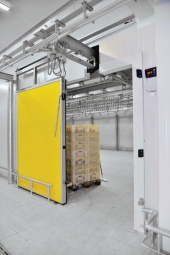
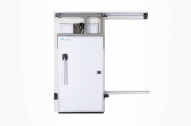
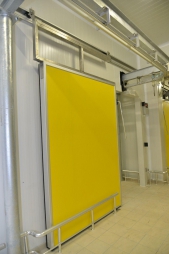
If overhead rail tracks pass through the opening and standard inlets cause clearance issues, workflow disruptions, and preventable wear, opt for the monorail sliding refrigeration door.
Cooler Entries That Clear the Rail
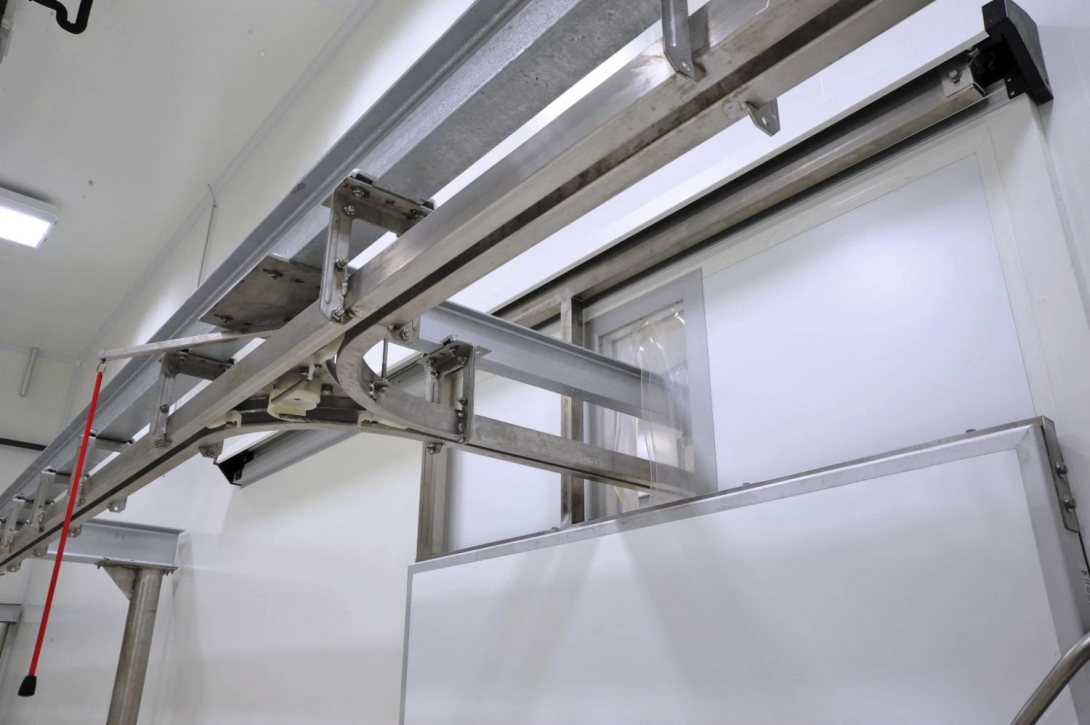
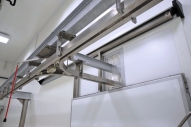
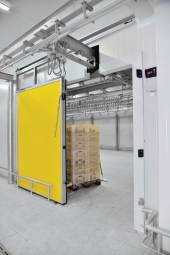
If an overhead rail passes through a cooling opening, this inlet can no longer be treated like a standard door location. The monorail sliding cooling door is the right choice when the opening needs to protect the room while also keeping the rail path clear, safe, and unobstructed without slowing down daily operations.
This is important because cooler entrances connected to an overhead conveyor system do more than just separate temperatures. They affect product flow, hygiene routines, maintenance access, and the long-term reliability of the opening itself. If the entrance does not conform to the track conditions, issues will arise in daily operations long before they appear on the technical specifications sheet.
The Real Problem Starts with the Opening
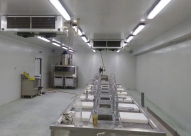
In facilities where products are transported via overhead conveyors, the refrigerated opening becomes an integral part of the production line. This completely changes the equation. The issue isn’t simply whether it’s a door to a room. The issue is whether the opening works in harmony with the track without causing strain.
This is where many projects lose efficiency. A refrigerated entrance may seem acceptable during the planning phase, but once air transport begins, the opening can become a source of hesitation, contact risk, cleaning difficulties, and repeated minor delays. Staff begin adjusting their movements to protect the opening. Loads are handled more cautiously than necessary. Maintenance teams begin to notice the tension around interfaces that have never been fully resolved.
In food processing, manufacturing, and refrigerated workflow environments, these small inefficiencies do not remain small. They translate into labor loss, operational inconsistency, and accelerated wear and tear at one of the room’s most critical points.
Why Do Standard Entrances Often Fail Under Monorail Conditions?
A standard refrigeration entrance is typically designed for ground-level traffic. People walk through it. Vehicles drive through it. Pallet jacks or racks move at floor level. This logic works until the opening needs to accommodate an overhead monorail or suspended load path.
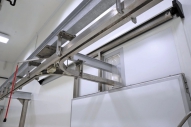
When the opening crosses the track, the entrance must solve a different problem. It must protect the envelope while respecting the overhead opening, the movement around the opening, and the physical relationship between the door and the track crossing. A door designed for a general cold room may still be the wrong choice here because it wasn’t designed with the overhead passage in mind.
This mismatch typically creates the same problem. The opening functions technically, but it never feels seamless. Operators slow down near the opening. Cleaning becomes more difficult. The surrounding area becomes more susceptible to wear and tear. Over time, the entrance begins to feel like a compromise rather than a proper part of the facility.
The Risk of Choosing a Door That’s Merely “Functional”
In rail opening conditions, a technically functional door is not always the right door. This distinction is important because the true cost of a poor choice usually becomes apparent after installation.
One risk is workflow friction. If the opening interrupts the flow of products in transit, every passage becomes more deliberate than necessary. This leads to time loss during every shift.
Another risk is premature wear and tear. When the clearance is not properly addressed, stress tends to build up in the hardware, gaskets, adjacent panels, protective components, and contact areas near the track. The system may remain operational, but it begins to age under greater stress than expected.
There is also a hygiene and compliance risk. Refrigeration inlets in food-contact or controlled environments should support cleaning routines, not hinder them. Narrow, impractical, or poorly coordinated interfaces can increase the cleaning burden and make it difficult to keep the area consistently clean.
There is also an issue of perception. An ill-fitting entrance typically leaves the same impression: it may be installed, but it wasn’t fully thought through. This feeling often leads to discussions about replacing it sooner, more frequent service interventions, and a decline in confidence in the overall room standard.
Why Is a Single-Track Sliding Refrigeration Door Better Suited for These Conditions?
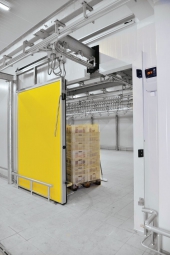
The single-track sliding refrigeration door is designed for a scenario where standard entrances fall short: a refrigeration opening where the track must pass through while still functioning as a reliable, insulated access point.
The advantage isn’t just that the door slides. The real advantage is that the opening can be planned around the rail opening, controlled access, and repeatable movement all at once. This provides a more consistent entry point for facilities where suspended loads, overhead conveyors, or monorail product movement are part of normal operations.
This makes the door particularly suitable in situations where the opening serves the following purposes:
- aerial product transfer between refrigerated areas
- processing rooms with suspended movement paths
- meat, food, or specialty product processing lines
- refrigerated zones where door swing would disrupt traffic flow
- facilities requiring a cleaner, more controlled interface at the opening
In these environments, the door is not merely a passive structural component. It is an integral part of the workflow. Therefore, a monorail sliding solution is generally more operationally sensible than attempting to force a traditional entrance into a specialized condition.
A Comparison That Truly Helps the Buyer
The most useful comparison here is not simply between “sliding and hinged.” The real decision is whether the entrance is selected for general access or for access to a refrigerated area with a rail opening.
| Access type | Best use case | Common drawback in rail conditions |
|---|---|---|
| Standard hinged cooler door | Personnel access and light routine entry | Swing path and overhead coordination create interference |
| Conventional sliding cooler door | Wider openings without rail-specific detailing | May not cleanly address the rail crossing condition |
| Monorail sliding cooler door | Cooler entries that must clear the rail | Needs proper integration with opening details and traffic logic |
Access Type Best Use Case Common Drawback in Rail Conditions
Standard hinged refrigeration door Personnel access and light routine entry Swing path and overhead clearance create an obstruction
Traditional sliding refrigeration door Wider openings without rail-specific detailing May not properly address rail clearance requirements
Single-track sliding refrigeration door Refrigeration entrances that must pass over the track Requires proper integration with opening details and traffic logic
This comparison is important because buyers often evaluate door types in very general terms. In reality, the decision should be based on opening conditions. If the opening is determined by the track, the door should be selected based on the track’s requirements, not a general access category.
What a Better Door Opening Solution Must Address
A robust solution must do more than simply allow passage. It must reduce the daily wear and tear caused by opening. This means the opening must support movement, protect the room, and remain manageable over time.
In practice, this often means thinking beyond the door panel itself. The opening may require coordinated attention to surrounding insulated panels, sealing points, hardware protection, service access, visibility, track edge details, and the practical needs of cleaning crews.
This is where experience matters. The Freezewize Cooling System treats monorail openings not as isolated door installations, but as an integral part of the operational refrigerated environment. This mindset helps customers avoid common mistakes, such as resolving only the door operation while leaving surrounding access conditions unaddressed.
Quick Decision Guide
A monorail sliding refrigerated door is generally a stronger choice when the opening is part of an overhead transport route and the rail must pass through the entrance without compromising continuous operational efficiency.
It is the right choice in the following situations:
- the refrigeration entrance must allow the track to pass through cleanly
- suspended loads pass through the opening daily
- swinging the door would disrupt workflow
- hygiene standards are high
- the access point is part of a production line
- the buyer wants less friction throughout the opening’s lifespan
If the opening is primarily for personnel access and overhead passage conditions do not dictate the area’s operation, a more traditional door may still be acceptable. However, if the track controls the movement pattern, the entrance must be designed with this in mind from the outset.
Related Solutions
A rail-free refrigeration access point typically performs best when planned in conjunction with surrounding room components rather than being evaluated as a standalone purchase. Relevant integration opportunities may include:
- refrigeration sliding door systems for adjacent non-single-track openings
- cold room insulated panels for cabinet integrity
- freezer and refrigeration entrance hardware for high-traffic access points
- impact protection solutions for processing and handling areas
- custom cold storage door configurations for application-specific layouts
These related solutions help buyers establish a more consistent opening strategy across the entire refrigerated area.
FAQ
Are monorail sliding freezer doors only for large processing facilities?
No. They are useful in any facility where the freezer opening needs to accommodate an overhead track in a controlled and repeatable manner.
What does “clearing the track” at the refrigerated entrance actually mean?
This means the opening is configured so the upper track can pass through without causing difficult door movements, operational hesitations, or a poorly resolved interface.
Can a standard sliding refrigerated door be used instead?
Sometimes, but this depends on how the track interacts with the opening. If the track’s condition dictates the entry, a custom monorail configuration is typically a more reliable choice in the long run.
Do these types of doors assist with hygiene planning?
Yes. A better-designed monorail entry can simplify managing the opening during routine cleaning and reduce challenging, hard-to-reach areas around the access point.
What should buyers consider before selecting a door?
They should consider traffic frequency, track alignment, opening size, the condition of surrounding panels, cleaning expectations, and long-term maintenance tolerance.
Is this primarily a temperature control decision?
No. Temperature control is important, but the bigger issue is access performance. The opening must support movement, usability, and room integrity all at once.
Conclusion
When a refrigeration door must pass over a track, the opening should be designed around the movement requirement, not a general door assumption.
If the track opening is defined, it should also define the access solution.
When daily suspended movement, hygiene requirements, and long-term durability are all equally important, a single-track sliding refrigeration door is often the most practical solution. For buyers evaluating a track-mounted refrigeration entrance, the next smart step is to review all clearance requirements and adapt the door to the actual workflow it must support.