




Cooler Door Planning for Rail Systems
2 Monorail Sliding Refrigerated Door Planning for Rail Systems | Access Guide
Plan the refrigerated openings around rail systems from the very beginning. The right monorail sliding refrigerated door reduces workflow disruptions, maintains hygiene, and prevents premature wear.
Cooler Door Planning for Rail Systems
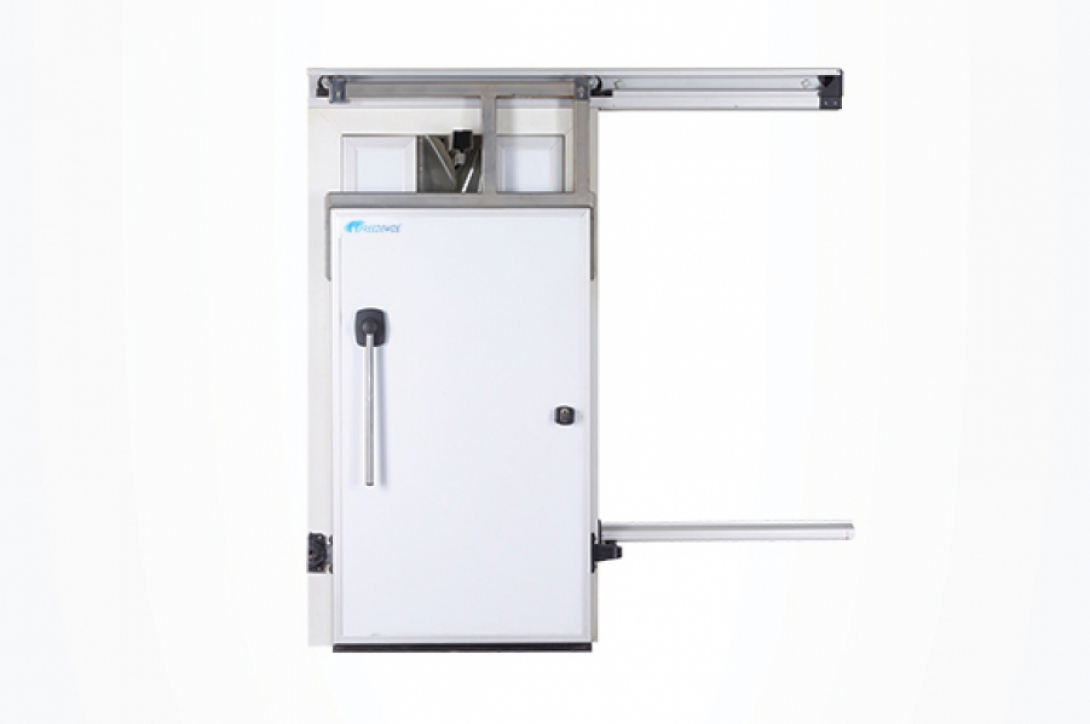
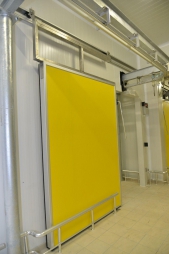
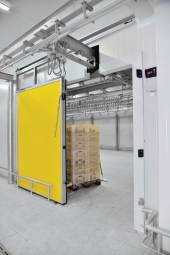
A monorail sliding refrigerated door is the right planning choice when a rail system passes through a refrigerated opening and the door opening must support overhead product movement without compromising access, hygiene, or temperature control. In these applications, the door is not merely a closing element; it becomes part of the workflow.
Therefore, planning for refrigerated doors in rail systems should begin with the workflow, not a general door category. If the opening is designed like a standard entrance, the result is typically slower movement, more difficult cleaning, more noticeable wear, and an access point that never feels fully resolved in daily use.
Planning Issues Begin Before Installation
Most issues with cold room doors do not begin after the room is built. They start during the planning phase, when the opening is treated as a simple door entry rather than a functional part of the rail system.
In facilities where product flow is suspended, the opening must do more than simply separate two environments. It must allow overhead passage, protect the insulated shell, support predictable movement, and remain manageable for cleaning and maintenance. This is a more demanding condition than standard personnel or cart access.
This is where many buyers and contractors encounter a preventable problem. A refrigeration door may appear acceptable on a drawing, but once the rail system is operational and products begin moving daily, the door opening can cause operations to slow down. Staff hesitate around the opening. Hygiene routines take longer. Surrounding equipment and panel areas begin to wear out sooner than expected. What seems like a simple door selection turns into a workflow issue.
Why Rail Systems Change Door Planning Logic
A track system changes the function of the opening. In a standard cold room, the door is typically planned with floor traffic, opening width, insulation, and basic durability in mind. In a track-based workflow, these factors remain important, but they are no longer sufficient.
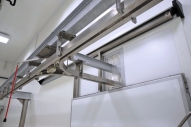
The opening must now be planned by considering ceiling movements, passage continuity, the opening along the rail path, sealing performance, visibility, access safety, and long-term serviceability. The door should support how the product moves within the room, not merely whether the room can be sealed.
Therefore, planning is critical here. If clearance and track conditions are not fully accounted for in the design, the operation typically pays the price in the form of slower movement, increased maintenance requirements, and pressure to replace the system sooner.
The Real Risks of Poor Planning Decisions
A refrigeration door may function technically, yet still be the wrong solution for a track system. This distinction is important because most access issues related to tracks do not appear in product specifications but emerge during actual use.
The first risk is workflow friction. When the suspended movement is forced to slow down in the opening, the entrance becomes a recurring bottleneck. In high-traffic refrigerated areas, even small delays can accumulate and lead to actual labor loss.
The second risk is the cleaning burden. If the door opening is not properly aligned with the track passage, maintaining consistent cleaning becomes difficult. In food-contact operations, this creates additional pressure when teams already have very little margin for inefficient routines.
The third risk is premature wear. Track-based openings concentrate usage in a very specific area. If the opening is not properly planned, gaskets, hardware, adjacent panels, and protective elements tend to show signs of premature wear.
The fourth risk is ownership costs. A door that appears to be poorly planned typically leads to the same long-term outcome: more service interventions, greater operator frustration, and an earlier need for modification or replacement.
Where Standard Door Planning Falls Short
Standard door planning usually begins with a familiar question: what kind of access is required to the room? This may be sufficient for general refrigeration applications. For rail systems, however, it is not sufficient.
A better question is how the opening functions within the movement pattern. If suspended products, carriers, or rail-mounted loads pass through the opening every day, the door is no longer a passive component. It becomes a controlled access point within the process itself.
For this reason, standard hinged or general sliding doors may still be unsuitable. They may meet the basic access requirements, but they may not be able to resolve the opening in a way that seamlessly supports overhead movement. The result is a room that works in theory but falls short in practice.
A Comparison to Help Buyers Plan Correctly
A comparison for rail-system openings should focus not just on door type, but on suitability.
| Door approach | Best fit | Common weakness in rail-system applications |
|---|---|---|
| Standard hinged cooler door | Light personnel entry and simple traffic patterns | Swing path and access behavior can conflict with overhead movement |
| Standard sliding cooler door | General wider openings without rail-specific planning needs | May not fully resolve clearance and passage around the rail |
| Monorail sliding cooler door | Cooler openings integrated with suspended rail systems | Best performance depends on coordinated opening design |
Door Approach Best Option Common Weakness in Rail System Applications
Standard hinged refrigeration door Light personnel entry and simple traffic flow Swing path and access behavior may conflict with overhead movement
Standard sliding refrigeration door General wide openings that do not require rail-specific planning May not fully resolve clearance and passage issues around the rails
Monorail sliding refrigeration door Refrigeration openings integrated with suspended rail systems Optimal performance depends on coordinated opening design
This comparison is important because the wrong choice is rarely a bad product. It is simply a product selected for the wrong opening condition.
What a Well-Planned Rail System Door Must Address
A well-planned opening must address more than just access. It must ensure that the rail passage feels intentional, controlled, and sustainable under real operational pressure.
This means the planning must consider the following:
how suspended loads pass through the opening
how the door interacts with the rail conditions
how the surrounding insulated panels support the opening
how seals and hardware perform during daily use
how cleaning crews access and clean the passageway
how maintenance crews reach service points without causing unnecessary downtime
how the opening looks and performs over time in a visible back-of-house environment
This is where project experience truly matters. The Freezewize Cooling System approaches rail-based refrigeration openings not merely as product placement but as operational conditions. This leads to better planning through the joint evaluation of doors, openings, and traffic flow.
Why Is a Monorail Sliding Refrigeration Door Usually the Most Practical Option?
When defining a rail-system opening, a single-rail sliding refrigeration door is typically a more robust solution. The advantage is not merely that the door slides. The deeper advantage lies in the ability to plan the opening around upward movement, cleaner passage, and reliable containment simultaneously.
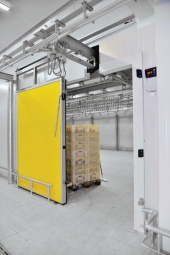
This makes such doors particularly suitable for refrigerated environments where overhead movement is a normal part of operations, such as processing lines, product transfer zones, and controlled cold storage areas reliant on repeatable overhead movement.
In these environments, the best results are achieved by planning the door as part of the workflow rather than treating it as a separate structural component. In this scenario, the opening typically performs better, feels more natural in use, and remains consistent with long-term hygiene and maintenance expectations.
Quick Decision Guide
When the opening is defined by a rail system rather than general room access, a single-track sliding refrigerated door is usually the right planning choice.
Choose this option in the following situations:
if overhead traffic passes through the opening daily
if the door is part of a production or transfer route
if standard door formats pose an obstacle
if hygiene and inspection readiness are critical in the opening
if maintenance tolerance is low
if long-term ownership value is more important than short-term simplification
If the opening is primarily for personnel access and the track configuration does not affect the door’s operation, a more standard door may still be suitable. However, if movement is track-dependent, the opening must be planned accordingly from the outset.
Related Solutions
Track system door planning typically yields the best results when integrated with a fully refrigerated opening strategy. Relevant internal link opportunities that naturally align with this topic include:
refrigerated sliding door systems
cold room insulated panels
freezer and refrigerator door hardware
impact protection for refrigerated traffic zones
custom cold storage entrance configurations
processing-specific door solutions for food facilities
These related solutions help establish a more consistent operational standard throughout the room, rather than allowing a single critical opening to bear too much of the load on its own.
FAQ
When should a refrigerated door be specifically planned around a rail system?
It should be planned this way when the rail passage directly affects how the product routinely passes through the opening.
Why is standard door planning for rail-based applications often insufficient?
Because standard planning typically focuses on basic access needs, while rail-based system openings also require compatibility with overhead movement, clean passage, and better long-term serviceability.
Is a single-rail sliding refrigerated door suitable only for large industrial facilities?
No. The determining factor is not the size of the facility. It is whether the overhead movement defines the opening and creates a specific access requirement.
What should contractors review in the early planning stages?
Before finalizing the door approach, they should review rail alignment, opening dimensions, traffic frequency, surrounding panel layout, hygiene requirements, and maintenance access.
Does this decision affect hygiene and inspection readiness?
Yes. A better-planned track opening is generally easier to maintain in accordance with cleaning, maintenance, and operational hygiene expectations.
Can a standard sliding door still work under certain track conditions?
In lighter applications, sometimes. However, if the track system is central to daily workflow, a specialized monorail sliding solution is generally a more suitable long-term choice.
Conclusion
Planning for refrigeration doors in track systems should begin with the movement pattern; because the opening is part of the process long before it becomes merely a door detail.
If the track opening is defined, it should also define the door planning decision.
When overhead movement, hygiene, workflow continuity, and long-term ownership are all equally important, a single-rail sliding refrigerated door is generally a more practical and durable solution. For teams planning a new refrigerated opening or retrofitting an underperforming one, the right approach is to fully assess the condition of the track and tailor the door solution to the operation’s actual requirements.