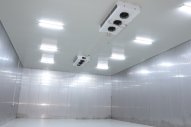





Workflow Obstacles in Cooled Entrances
Side-opening refrigerated door for refrigerated loading docks | Reduce bottlenecks in workflows
Bottlenecks at refrigerated loading docks slow down work, increase wear and tear from contact, and disrupt traffic in the cold room. A properly designed side-opening refrigerated door helps streamline access.
Workflow Obstacles in Cooled Entrances
A side-opening refrigerated door is often the ideal solution when a refrigerated entrance begins to slow down work around it instead of facilitating it. In high-traffic cold rooms, the door opening is not just a dividing point between spaces. It is part of the workflow. When this workflow becomes hesitant, congested, or impractical in daily use, the entrance turns into a bottleneck.
This is important because bottlenecks at refrigerated entrances aren’t limited to the door itself. They affect the pace of work, the movement of carts, restocking speed, hygiene routines, and the overall atmosphere of the room. Choosing the right access solution allows the opening to integrate into the workflow rather than disrupt it.
Where Do Cold Room Entry Bottlenecks Really Come From?
Most bottlenecks don’t start with a major failure. They start with small delays that repeat throughout the day.
A staff member slows down before entering. A cart stops at the threshold. A shelf must be tilted to pass through the opening. Another employee waits a moment to pass in the opposite direction. Someone has to exert more force because the movement doesn’t feel natural. None of these moments seems serious on its own. Together, they turn the door into a point of friction.
This phenomenon is particularly common in refrigerated environments associated with food preparation, supermarket backrooms, storage areas, distribution zones, and processing facilities. These are not spaces where the door is used only occasionally. The entrance is an integral part of the daily workflow, product flow, cleaning activities, and internal time management.
As soon as the entrance begins to slow down movement, the impact extends beyond the opening itself. Order preparation takes longer. Restocking becomes less fluid. Staff routes lose efficiency. Repeated contact with the frame and lower sections increases. The room may remain cold and technically functional, but the access point no longer seems suited to the activity.
That is the real problem. A refrigerated entrance can maintain a separate temperature while still being a poor choice in terms of workflow.
Why a bottleneck costs more than it seems
A slow refrigerated entrance doesn’t just cost a few seconds. It alters the operation of the entire surrounding activity.
In high-volume U.S. facilities, pressure on the workflow is rarely caused by a single dramatic delay. It results from repetition. If a door causes even a slight hesitation dozens or hundreds of times per shift, the effect ripples through workforce efficiency, handling pace, and attention to maintenance.
Poor entrance configuration often leads to:
- slower throughput during peak periods
- increased congestion at the threshold
- repeated contact with carts, bins, and mobile racks
- more visible wear around impact zones and hardware
- greater difficulty cleaning the entrance
- a growing sense that the room’s entrance was not chosen based on actual operating conditions
This is why bottlenecks deserve special attention. The entrance doesn’t have to break down to become costly. It’s enough for it to disrupt traffic often enough.
In many facilities, this is exactly what happens. The door still works, but the opening no longer facilitates passage.
Why bottlenecks worsen in refrigerated environments
A refrigerated entrance is under more pressure than a standard interior door.
It must allow traffic to flow while providing separation, meeting cleaning requirements, and withstanding cold room conditions. This combination makes the opening more demanding. Staff don’t just walk through it. They walk through it while carrying products, moving shelving, pushing carts, managing the risk of cold air loss, and working to tight schedules.
This is why a poorly designed entrance tends to become noticeable more quickly in cold rooms than in standard work areas. The door is integral to productivity, hygiene, and space management.
When passage is slow or inconvenient, staff begin to adapt their behavior accordingly. This adjustment marks the beginning of a bottleneck effect. The workflow adapts to the door, whereas the door should be supporting the workflow.
A comparison that clarifies the choice
When refrigerated entrances begin to create bottlenecks, the key decision isn’t simply about the type of door available. The real question is which access method best supports the traffic pattern at the opening.
A hinged refrigerated door is generally the best choice when the opening is subject to repeated, short-cycle use, two-way staff movement, and regular traffic from carts or shelving. A standard hinged refrigerated door often works well in low-traffic areas where access is more deliberate. A sliding solution may be preferable when wider openings or heavier loads present a challenge.
| Door Type | Best solution | Main advantage | Main limitation |
|---|---|---|---|
| Refrigerated swing door | High-traffic entrances with repeated bidirectional movement | Smoother traffic flow in high-traffic areas | Must be adapted to the type of traffic and the characteristics of the opening |
| Standard hinged refrigerated door | Low to moderate traffic, more controlled access | Simple and familiar operation | May cause hesitation in environments with a faster pace |
| Sliding refrigerated door | Wider openings, larger load movements, layouts sensitive to clear space | Ideal for managing passage width and space | Less natural for fast, constant foot traffic |
This comparison is important because many buyers focus on the room itself and underestimate traffic behavior at the opening. This is how bottlenecks arise in otherwise high-performing refrigerated spaces.
Why a double-leaf refrigerated door solves the problem
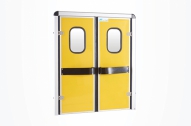
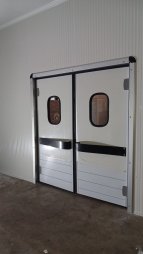
A double-leaf refrigerated door is often the best solution because it directly resolves friction-related movement issues.
In a high-traffic cold room, the goal is not just to allow access. The goal is to maintain continuous flow without the entrance feeling like a bottleneck. A double-leaf configuration helps achieve this by enabling a more natural flow pattern in environments where staff and mobile equipment move repeatedly throughout the day.
This makes a tangible difference. When the opening better adapts to actual movement, staff hesitate less, congestion decreases, and it becomes easier to pass through the door even under pressure. This can improve the room’s day-to-day usability, even when the bottleneck didn’t seem serious on paper.
The solution becomes more effective when the entire entrance is taken into account, rather than just the door leaf. In many refrigeration applications, workflow bottlenecks are influenced by:
- the threshold design
- the frame fit and the width of the opening
- the seal’s performance during repeated cycles
- visibility through the entrance
- impact protection
- integration of surrounding panels
- how carts, shelving, and personnel actually approach the entrance
This is where the Freezewize cooling system truly comes into its own in practice. The best choices for refrigerated doors are generally based on an evaluation of the door within the overall context of the operating environment. A swing door performs best when selected based on actual traffic, actual cleaning routines, and actual daily movements, rather than on generic specifications.
Factors to Consider Before Making a Choice
If a refrigerated entrance slows down the workflow, the choice of door must be based on operational behavior.
The most useful questions are not, at first glance, overly technical. They are operational in nature.
How many door cycles occur during a typical workday?
Does traffic consist mainly of people, carts, shelving, or a mix of both?
Does traffic come from both directions?
Does the opening create bottlenecks during peak traffic periods?
Does the threshold area show signs of wear from contact or cleaning difficulties?
Is the entrance part of a visible rear area where appearance is important?
What level of maintenance can the facility reasonably handle?
These questions help determine whether the problem actually concerns the refrigeration system, the type of access, or long-term suitability. In many cases, the bottleneck is not caused by a defective door. It is caused by a door that was never perfectly suited to the operating conditions.
Quick Decision Guide
Choose a swing-type refrigerated door when:
- the entrance is used frequently on a daily basis
- traffic flows in both directions
- carts, bins, or shelving regularly pass through the opening
- work speed is critical and stops at the entrance cause delays
- the operation requires the entrance to remain unobstructed despite repeated use
Opt for a more traditional hinged solution when:
- traffic is less dense and better controlled
- traffic is less frequent
- movement is primarily one-way or deliberate
- The opening is not used as a constant passageway for traffic
Choose a sliding solution when:
- the opening is wider
- bulky objects need to pass through more easily
- the conditions of the adjacent space make a swing door less suitable
- the main consideration is the geometry of the opening rather than frequent, short-cycle traffic
The most obvious rule is simple: if the door functions as a passageway, it should be chosen accordingly.
Related Solutions
If bottlenecks at refrigerated entrances are driving the decision, these related solutions are often worth considering in addition to a refrigerated swing door:
- swing doors for cold rooms intended for low-traffic refrigerated areas
- sliding cold room doors, for wider openings and greater product movement
- cold room panel systems for better integration of openings
- freezer room door solutions for low-temperature areas
- impact protection and baseboard options for high-traffic entrances
- Glazed panel and hardware configurations for safer and smoother traffic flow
FAQ
What causes bottlenecks at refrigerated entrances?
Generally, repetitive short-cycle traffic, awkward passageways, contact with carts, an ill-suited opening, and a door type that doesn’t match daily traffic flow.
Is a double-leaf refrigerated door better suited for high-traffic cold rooms?
In many high-traffic applications, yes. It often allows for smoother movement and reduces hesitation when opening.
Can a standard-hinged refrigerated door still work well?
Yes, when traffic is moderate and better controlled. It is often well-suited for less demanding entrances.
Why is the entrance so important in refrigeration operations?
Because it affects workflow, cleaning routines, wear and tear from contact, and the efficiency with which people and products enter and exit the cold room.
Should carts and shelving influence the choice of door?
Absolutely. Regular mobile traffic changes the requirements for opening the door and often makes the choice of access type much more important.
What is the biggest design mistake regarding cold room entrances?
Treating the door as a simple closure rather than as a component of the daily workflow.
Conclusion
Bottlenecks in workflows at refrigerated entrances are rarely caused by a single major issue. They result from repeated minor interruptions that, little by little, turn the passageway into a hindrance to the entire operation.
The best cold room entrance is one that maintains a smooth flow of movement once the actual daily workload sets in.
If the entrance to your cold room causes delays, congestion, or frequent contact during normal use, a properly fitted side-hinged refrigerated door is often the most sensible long-term solution. A careful assessment of traffic patterns, opening conditions, and access requirements typically resolves much more than just the door itself.