




Where Misfit Doors Raise Costs
Side-Opening Refrigerated Doors for Cold Rooms | When Poorly Fitted Doors Drive Up Costs
Poorly fitting cold room doors increase workload, maintenance demands, and the risk of replacement. A properly fitted side-opening refrigerated door improves traffic flow and reduces operational friction.
Where Misfit Doors Raise Costs
A side-opening refrigerated door is often the ideal solution when a cold room entrance generates costs not because of an obvious failure, but due to daily wear and tear. In high-traffic cold rooms, a poorly fitted door can slow down staff movement, suffer repeated impacts, complicate cleaning, and require more maintenance well before anyone considers it a serious problem.
This is why unsuitable doors increase costs in ways that many buyers do not immediately recognize. The problem rarely lies in the purchase price alone. The true cost manifests itself in workflow friction, premature wear, increased maintenance, and a growing sense that the door was not selected based on the cold room’s actual operation.
The cost problem starts with the door
In many facilities, cost pressures in cold rooms are attributed to refrigeration equipment, labor inefficiency, or general wear and tear. But the entrance is often part of the problem.
A cold room door is one of the most heavily used components in any refrigerated space. Staff pass through it all day long. Carts pass through it during loading, restocking, or preparation. Shelving and bins bump into the impact zones. Cleaning crews work around thresholds, gaskets, and hardware. The opening is not just a passive boundary. It is part of the operational workflow.
When this workflow revolves around an ill-suited door design, costs begin to mount up due to repeated minor incidents. People stop at the opening. Contact points increase. Surfaces wear out faster. Hardware is subjected to greater stress. Cleaning becomes more tedious than it should be. The room may still function properly in terms of temperature, but the entrance begins to behave like an undersized part of the system.
This is where unsuitable doors drive up costs. Not always because of a spectacular failure, but because of repeated friction that becomes common enough to be ignored and costly enough to matter.
Why a door can work while still being a poor choice
One of the most common purchasing mistakes in refrigeration projects is assuming that a door is suitable simply because it works technically.
A door may open, close, and provide sufficient insulation. But if it is not suited to the traffic flow, impact level, cleaning routines, or access speed of the room, it may still be a poor choice. In real-world U.S. installations, this mismatch typically becomes apparent during operation before it even appears on a quote.
A poor choice often results in:
- slower throughput during peak periods
- more damage from impacts caused by carts, shelving, and repeated traffic
- increased wear on edges, bottom edges, hinges, seals, and thresholds
- more maintenance than the facility’s size would normally require
- a less hygienic appearance in visible back-of-house areas
- pressure for early replacement, even if the door has never completely failed
This is the real challenge for the owner. An unsuitable door turns daily use into a source of avoidable costs.
Where hidden costs typically arise
Unsuitable doors rarely result in costs in a single, obvious category. They create a series of small operational constraints that ripple throughout the entire facility.
Staff efficiency is often the first area affected. If staff lose even a little time at the entrance to a cold room, that loss accumulates over the course of a shift. The door becomes a point of delay rather than an element that promotes smooth traffic flow within the room.
Maintenance demands follow closely behind. When a door is exposed to traffic or impacts exceeding those for which it was designed, adjustments and maintenance due to wear and tear become more frequent. This may not always seem dramatic on paper, but it leads to continuous service interruptions.
Cleaning demands also increase. Entrances that experience more contact, hard-to-clean areas, or repeated impacts on the bottom panel are harder to keep clean and in good working order. In food and refrigerated operations, this matters both operationally and visually.
The timing of replacement also changes. A door that is merely acceptable on day one may start to look outdated too soon. Buyers then have to bear the cost of correcting a choice that was technically functional but operationally unsuitable.
This is why the access option that seems the cheapest can become one of the most costly mistakes in the long run.
Why are mismatches so common?
Mismatches generally do not occur because a poor product was intentionally chosen. They occur because the opening was evaluated too narrowly.
In many projects, the discussion remains focused on insulation, dimensions, or the basic type of access. These points are important, but they are not enough. A refrigerated entrance must also be evaluated based on daily traffic volume, direction of traffic flow, use of carts, exposure to impacts, cleaning frequency, service access, and how the room performs under actual operating conditions.
A door suitable for a low-traffic cold room may not be suitable for a busy prep area. A door that works in a controlled storage space may seem unsuitable in a supermarket’s backroom. A door that seems suitable on paper can create daily difficulties in a real-world warehouse or food processing environment.
A mismatch is generally a fit issue, not just a product issue.
A comparison that clarifies the decision
When costs rise at the entrance, the right comparison isn’t about determining which door seems most appealing in theory. The real comparison is about determining which access method matches the room’s operational needs.
A swing-style refrigerated door is generally the wisest choice when the opening is subject to frequent, short-cycle traffic, repeated bidirectional movement, and the regular passage of carts or shelving. A conventional hinged solution often works well when traffic is less intense and better controlled. A sliding door may be preferable when opening width, clearance, or a larger transfer volume become priority considerations.
| Door Type | Best fit | Main advantage | Main cost Risk in case of misuse |
|---|---|---|---|
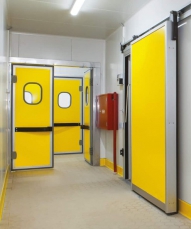
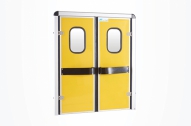
| Refrigerated swing door | High daily traffic, two-way movement, frequent passage | Promotes smoother traffic flow and better adaptation to daily use in high-traffic entrances | Insufficient performance only if selected without considering opening details and traffic type |
| Standard hinged refrigerated door | Low to moderate traffic, more controlled access | Simple and practical in low-traffic environments | May result in additional workload and wear out more quickly with heavy use |
| Sliding refrigerated door | Wider openings, larger product movements, layouts sensitive to available space | Better suited to high-traffic needs and opening control | May not be suitable when the smooth flow of foot traffic is the primary concern |
This is where the purchasing logic becomes clearer. The right door isn’t just the one that closes the room. It’s the one that meets the cost constraints associated with the room’s daily use.
Why a refrigerated swing door often reduces cost pressure
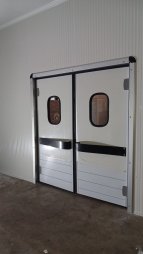
A side-hinged refrigerated door often makes sense because it addresses the practical reasons why an unsuitable door becomes costly.
In high-traffic cold rooms, people do not use the entrance like occasional visitors. They use it as part of their workflow. They pass through it in a hurry, carrying loads, and in repeated cycles that transform the entrance door into a functional element. If the door does not adapt to this pattern, it creates hesitation, friction, and strain.
A well-suited swing door solution helps reduce this friction. It allows for a more natural movement through the opening, withstands repeated use, and can give the impression that the room is better suited to actual traffic flow rather than theoretical traffic flow. This does not eliminate costs per se, but often reduces the operating conditions that drive up avoidable costs.
This advantage is even more pronounced when the opening is considered as a complete system rather than just a door leaf and frame. Threshold details, sealing performance, visibility, impact protection, hardware durability, panel integration, and access for maintenance are all factors that determine whether the door remains cost-effective over time.
This is where the Freezewize cooling system makes practical sense. In real-world projects, reducing property-related friction typically results from selecting a door based on traffic patterns, hygiene routines, and long-term usage conditions, rather than a narrow description of the product alone.
The decision should be based on the cost of ownership, not just the purchase price
Buyers and contractors are often under pressure to control initial expenses. This is normal. But cold room doors should not be judged solely on the basis of purchase price or mere compliance with specifications.
The most relevant question is: What will be the cost of using this door?
This involves examining the door’s performance in real-world conditions, how often it will be operated or subjected to impacts, how easy it is to clean and maintain, and how long it will remain suitable before service becomes necessary. In many cases, the best financial decision is not the cheapest door. It is the door that causes the least hassle over the years of use.
This is particularly true in refrigerated environments where labor, availability, hygiene, and the timing of replacement are all important factors for the business.
Quick Decision Guide
Choose a swing-style refrigerated door when:
- opening requires frequent daily access
- traffic flows in both directions
- staff, carts, shelving, or bins regularly use the entrance
- workflow speed is critical, and any hesitation at the door slows down traffic
- long-term suitability takes precedence over minimizing initial compromises
Opt for a more conventional hinged solution when:
- traffic is less dense and better controlled
- entrances are less frequent
- the opening is not used as a constant passageway
- impact exposure and cleaning pressure are moderate
Choose a sliding solution when:
- the opening is wider
- moving bulky products is the main concern
- clearance conditions around the opening are more important than foot traffic
- the operational issue lies in the geometry of the passageway rather than in frequent, short-cycle access
The most obvious rule is simple: the cheapest door on paper often becomes the most expensive to use when it is not suited to the room.
Related Solutions
If the increased cost of doors is a factor in the decision-making process, these related solutions are often worth evaluating alongside a refrigerated swing door:
- swing doors for cold rooms designed for low-traffic refrigerated areas
- sliding cold room doors, for wider openings and more spacious transfer passages
- cold room panel systems for better integration of openings
- cold room door solutions for low-temperature applications
- upgrades to thresholds, seals, and hardware for high-traffic entrances
- Impact protection and glass panel options for high-traffic backstage work environments
FAQ
What makes a cold room door unsuitable?
A door is unsuitable when it functions technically but does not match the room’s actual traffic, cleaning routine, impact exposure, or access patterns.
How do unsuitable doors increase costs?
Generally by slowing down work, increasing wear and tear, requiring more maintenance, making cleaning more difficult, and creating pressure for early replacement.
Is a swing-style cold room door more cost-effective in high-traffic cold rooms?
In many high-traffic applications, yes. It often reduces friction in the workflow and better accommodates repetitive movements than a less suitable access type.
Can a standard hinged door still be the right choice?
Yes. It can be a very good choice in low-traffic rooms where access is controlled and the door is not subject to constant daily wear and tear.
What is the most commonly overlooked cost associated with a refrigerated entrance?
Recurring operating costs. Minor delays, repeated contact, and avoidable maintenance operations often cost more over time than buyers anticipate.
Should thresholds, seals, and hardware be factored into the cost decision?
Absolutely. The long-term cost of a door depends on the entire opening system, not just the panel itself.
Conclusion
Inappropriate doors increase costs because they turn a necessary access point into a recurring operational expense.
The most cost-effective cold room door is the one that remains operational from the very start of daily use, not just the one that seems acceptable at the time of purchase.
If your cold room entrance is causing friction, wear, or maintenance needs that are disproportionate to its role, the problem may not be solely due to its age. It could be a fit issue. A careful examination of traffic patterns, opening conditions, and access types can prevent a seemingly innocuous door choice from turning into a long-term ownership cost.