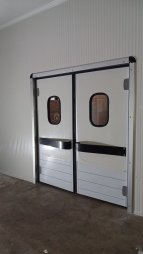





Reducing Downtime at Freezer Entries
Reduce downtime at cold room entrances with sliding doors
Sliding doors for freezers reduce downtime at high-traffic freezer entrances by improving access flow, reducing strain on equipment, and helping facilities avoid repeated service interruptions.
Reduce downtime at cold room entrances
A cold room sliding door is often the best choice when cold room entrances are subject to constant use, repeated impacts, and daily operational pressure that can turn the opening into a maintenance issue. In many facilities, downtime doesn’t start with a major cold room failure. It begins at the entrance, where traffic slows down, equipment wears out prematurely, and minor access issues start to disrupt operations.
That is why the design of the cold room entrance is more important than it may seem at first glance. When the opening is difficult to manage, the cost is not limited to mere inconvenience. It affects workflow, maintenance schedules, cleaning routines, temperature compliance, and the overall reliability of the cold room.
Downtime usually starts with minor access issues
Most cold room entrance-related downtime doesn’t happen all at once. It builds up as a result of repeated friction at the opening.
A cart hits the edge of the door. Staff hesitate at the threshold during heavy traffic. The hardware requires adjustment sooner than expected. The seals begin to lose their effectiveness. Ice or signs of wear appear around parts of the opening subjected to repeated stress. None of these problems seems critical on its own, but together, they create a cold room entrance that begins to require more frequent attention than it should.
This phenomenon is particularly common in environments where access to the freezer is part of the daily production cycle. Warehouses, food processing facilities, supermarket service areas, distribution spaces, and commercial kitchens all rely on freezer doors capable of keeping pace with operations. If the door becomes fragile, difficult to operate, or slow, the room can continue to function, but it no longer seems reliable.
Why freezer entrances become critical points
A cold room can be well-designed overall yet suffer from a flawed access strategy. This happens when the door is treated as a simple point of entry rather than a high-traffic operational zone.
Freezer entrances are subjected to greater stresses than many other elements in the room. They must withstand repeated opening cycles, the stress of low temperatures, impacts from carts or pallet jacks, exposure to cleaning, sealing pressure, and constant human use. If the door system is not selected with these realities in mind, the entrance begins to become a maintenance black spot.
In practice, the problem rarely lies in the fact that the door simply doesn’t work. The problem is that it no longer operates smoothly. Opening the door begins to require more adjustments, more precautions, more clearance, or more repair planning than operations can comfortably accommodate. This is where the risk of downtime begins to rise.
The Real Cost of Downtime at the Cold Room Entrance
Downtime at the entrance to a cold room has more significant consequences than many buyers realize. The immediate problem may involve the door, but the operational repercussions extend far beyond the door itself.
The first cost is lost travel time. If staff cannot pass through the opening smoothly, the workflow slows down immediately. This may seem insignificant for a single trip, but over the course of a shift, it becomes a measurable hindrance to staff efficiency.
The second cost is the maintenance burden. Frequent interventions at the entrance create scheduling pressure, service interruptions, and avoidable distractions for facility teams. Even short maintenance shutdowns are disruptive when they affect a heavily trafficked freezer aisle.
The third cost is temperature exposure. A door that sticks, hesitates, is misaligned, or becomes difficult to operate often remains open longer than intended. This creates greater thermal disturbances at the threshold and can make it harder to maintain consistent room temperature control.
The fourth cost is the pressure to replace the door prematurely. A freezer door that appears worn out too soon usually signals a mismatch between the access system and the workload. The system may still function, but it begins to give the impression that a poor decision was made from the start.
When the wrong door choice leads to more downtime
A door may be technically acceptable while still posing an unacceptably high risk of downtime for the application. This is where many decisions regarding freezer doors go wrong.
A lighter-duty access model may seem sufficient during planning, especially when the discussion focuses on size, basic insulation, or initial cost. But once the room is in daily operation, other factors take precedence: traffic frequency, opening width, rolling equipment, surrounding clearance, impact exposure, cleaning pressure, and maintenance tolerance.
When these factors are underestimated, the result is predictable. The entrance becomes more difficult to use under real-world conditions. Maintenance needs increase. Minor repairs multiply. The room continues to operate, but the entrance can no longer keep pace with operations.
Sliding or swing doors for high-traffic freezer entrances
For facilities seeking to reduce downtime, the most important comparison generally involves sliding doors versus swing doors for cold rooms.
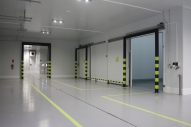
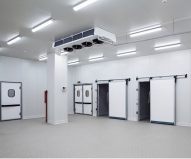
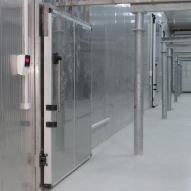
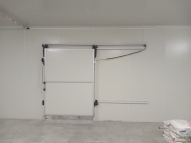
A swing door may still be the right choice for small or low-use freezers. But when the entrance is located on a high-traffic route or must handle repeated movements throughout the day, a sliding system often results in fewer interruptions, as it removes the swing door’s path from the work area.
| Decision Factor | Sliding freezer door | Swing freezer door |
|---|---|---|
| Suitable for high-traffic entrances | Better suited for repeated daily use | Better suited for more frequent access |
| Clear space around | Allows for better use of adjacent space | Requires maneuvering space |
| Traffic of carts and pallet jacks | Allows direct passage | May interrupt the traffic flow |
| Impact management | Easier planning around the entrance area | The door leaf is often subjected to repeated contact |
| Maintenance pressure | Often lower when the right choice is made | May increase more rapidly with intensive use |
| Control of downtime | Better for active freezer circuits | Better in simpler configurations |
This comparison is important because downtime is not solely related to breakdowns. It also depends on how often opening the door disrupts normal operations.
Why sliding freezer doors help reduce downtime
A sliding freezer door reduces downtime by addressing several operational weaknesses at once.
First, it improves traffic flow. Because the door slides sideways, personnel and rolling equipment can pass through the opening more directly. This reduces hesitation, minimizes space conflicts, and makes the entrance easier to use under pressure.
Second, it helps reduce avoidable collisions. In high-volume freezing operations, repeated contact is rarely accidental. It results from a door system that is ill-suited to the traffic flow. A sliding configuration generally provides a smoother movement pattern for the opening and makes it easier to protect the surrounding entry area.
Third, it supports a more sustainable maintenance strategy when properly specified. In the demanding conditions of cold rooms, reliability does not depend solely on the door panel. The design of the tracks, the quality of the rollers, the performance of the seals, the frame details, the threshold mechanism, and the protective elements all influence the stability of the entrance during repeated use.
This is why a well-suited sliding system is often a choice aimed at reducing downtime rather than a mere preference regarding door style.
What a door system focused on minimizing downtime must include
If the goal is to reduce interruptions at cold room entrances, the full opening must be specified based on daily operating conditions.
A more robust system generally includes:
- an insulated door structure suitable for freezing temperatures
- heavy-duty track and roller hardware for frequent cycles
- sealing details that ensure a consistently effective seal
- Threshold design suitable for pedestrian and vehicle traffic
- Perimeter protection in areas prone to repeated contact
- Frame design ensuring long-lasting alignment
- Optional transparent panels where visibility improves safety
These details are important because downtime is rarely caused by a single major failure. It generally results from multiple small failures that accumulate over time. A cold room door performs better when the system is designed to support the load, not simply to close an opening.
Adapt the entrance to the operation
Not all cold room doors are subjected to the same pressure. A small room with occasional access will not require the same solution as a distribution cold room or a back-of-house room used continuously every day.
The appropriate choice depends on the actual operating conditions:
- the frequency of door use
- whether traffic consists mainly of personnel, carts, or pallet jacks
- the required passage width
- the available clearance on the sides around the opening
- the strictness of cleaning and inspection procedures
- the downtime the system can tolerate
- the expected lifespan of the system before a major replacement
When these questions guide the specification, the result is generally better suited for the long term. This is also where system-level thinking becomes more valuable than a purchase focused solely on the product. The Freezewize cooling system is particularly useful when access to the freezer is integrated into the operational workflow rather than viewed as a mere piece of equipment.
Quick Decision Guide
Choose a sliding freezer door when access is located in a high-traffic area and the facility wants to reduce service interruptions, streamline movement, and ensure better long-term suitability.
This is generally the best option when:
- access to the freezer is used throughout the day
- trolleys, shelving, or pallet jacks pass through the opening
- the space required to open a swing door would interfere with nearby activities
- the opening is wide enough that using a hinged door seems inefficient
- the site has low tolerance for recurring downtime for maintenance
- Long-term availability takes precedence over short-term simplicity
A swing door may still be suitable in smaller rooms where traffic is limited and access requirements are simple. But when entrance availability is critical, a sliding access solution generally offers a more reliable operational outcome.
Related Solutions
Installations concerned with cold room entry availability often consider the components of the adjacent cold room in parallel. The most relevant related solutions generally include:
- insulation panels for cold rooms
- heated frame and seal solutions
- threshold systems for pallet jack and cart traffic
- impact protection around cold room openings
- sealing and hardware assemblies for cold room doors
- Cold room layout planning for high-traffic access areas
These related pages help buyers understand the link between minimizing downtime and ensuring optimal performance of the freezing environment.
FAQ
Do sliding freezer doors reduce downtime in high-traffic facilities?
Yes, they do in many high-traffic applications. They generally promote smoother traffic flow, reduce access friction, and help alleviate the stress of repeated use at the opening.
Why do cold room entrances require more maintenance than expected?
Because the entrance undergoes repeated cycles, impact risks, exposure to low temperatures, and constant movement. If the system is not suited to this workload, maintenance needs increase more rapidly.
Are freezer sliding doors better suited for pallet jack traffic?
Often yes, especially when the opening width, threshold condition, and protective elements are designed from the outset for forklift traffic.
Can an unsuitable door type increase operational downtime?
Absolutely. An unsuitable door can slow down traffic, increase wear and tear, raise adjustment needs, and make the entrance more likely to disrupt daily operations.
What matters most when choosing a cold room entrance door?
Above all, suitability is key. Traffic flow, opening width, clearance, hardware durability, sealing efficiency, and ease of maintenance should all guide the decision.
Is a swing door ever the right choice for a cold room?
Yes. It can be perfectly suitable for smaller, less-frequented rooms where the door is opened less often and the surrounding space is not under heavy pressure.
Conclusion
To reduce downtime at cold room entrances, it is important to first recognize that the door is not a minor component. It is a key element of daily operations that directly affects access, maintenance, and the reliability of the cold room.
The best cold room entrance is one that does not interfere with work while withstanding heavy use.
For facilities planning a renovation or the construction of a new cold room, a practical assessment of traffic volume, service expectations, and access conditions will generally lead to a more informed and sustainable decision regarding access.