




Freezewize | Industrial Cooling Systems & Custom Cold Room Solutions

Hinged Access Beneath Monorail Systems

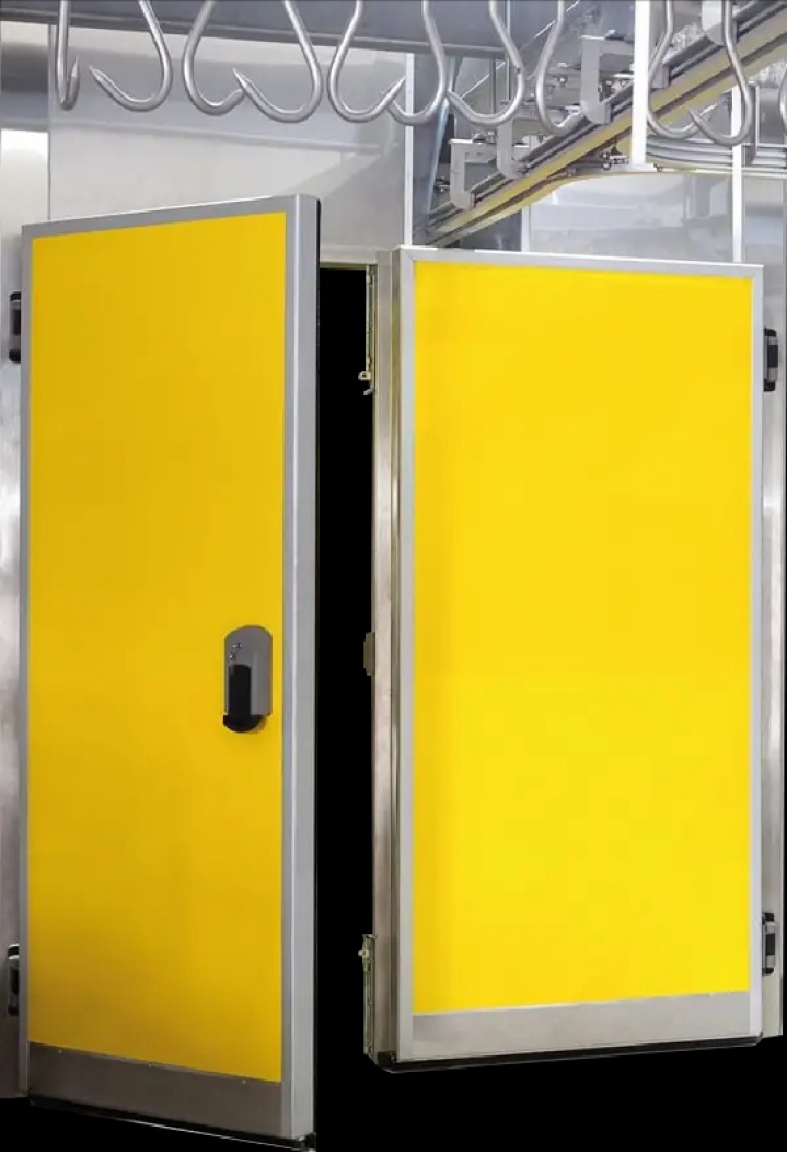
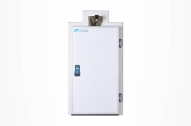
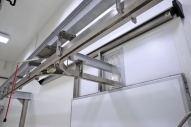
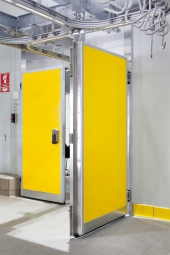
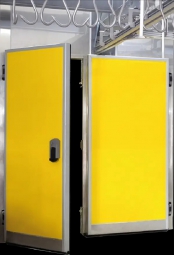
Monorail-Hinged Cold Cooler Room Door for Efficient Access Under Overhead Track Systems

When overhead track systems restrict standard door movement in cold storage areas, the monorail-hinged cold storage room door helps facilities maintain space, workflow, and hygiene.

Hinged Access Beneath Monorail Systems

The monorail-hinged cold room door is the ideal door solution designed to provide safe and efficient access beneath overhead rail tracks. Particularly in meat processing, food production, distribution, and cold storage facilities, when standard door choices conflict with the rail system, daily operations slow down, maintenance demands increase, and the access point becomes the weak link in the operation.

The right solution is not merely about closing the opening. The door’s opening direction, panel thickness, hardware placement, field of view, threshold detail, and impact resistance must be considered in conjunction with personnel working beneath the monorail track, suspended product flow, vehicle traffic, and cleaning routines. Therefore, the real issue here is not the door itself, but whether the access system truly fits the site.

The Problem Isn’t That the Door Doesn’t Work; It’s That It Doesn’t Fit the Space

In cold storage areas with monorail systems, the problem is rarely simply whether “the door opens.” The real issue is whether the door will function correctly in that opening and within that workflow over the long term.

Overhead rail tracks complicate standard hinged access plans. Incorrect door selection is immediately noticeable, especially under the following conditions: 

  • If personnel traffic and the overhead product line intersect in the same area.
  • If there is movement of hand trucks, shelves, or pallet jacks in front of the opening.
  • If the door panel comes into close contact with the track, hardware, or surrounding equipment when opened.
  • If the cleaning routine is aggressive and daily.
  • If the visible back-of-house layout is critical.
  • If tolerance for cold chain loss is low.

In such areas, an access point is not merely a passageway. It is also an operational component that directly impacts temperature control, workflow, hygiene perception, and maintenance burden.

The Operational Cost of a Wrong Choice

A door may be technically installed and still be the wrong choice. This situation is very common in access openings under monorails because a solution that works on paper can create friction on-site.

The most common consequences of a wrong choice are as follows:

Opening Interference

The door panel opens theoretically, but creates an uncomfortable proximity to the track, suspension equipment, or personnel pathways. This forces users to handle the door carefully, slow down, and eventually strain the hardware over time.

Impact and Premature Wear

Areas with monorails are typically active work zones. In these areas, the panel, frame, viewing panel, bottom edge, and hardware are at risk of impact. Doors with insufficient protective details quickly give the impression that “a sturdier choice should have been made from the start.”

Hygiene and Cleaning Demands

In food processing or controlled production areas, the cleanability of the door is just as important as its design. Surfaces that are difficult to clean, improper joint details, and hard-to-reach hardware points unnecessarily prolong daily sanitation routines.

Heat Loss

If a door tends to be misused, remains open longer than necessary, or fails to develop a habit of closing properly, it silently degrades cold room performance. This may not create a major problem immediately, but over time, it leads to increased energy consumption and pressure on temperature stability.

Increased Maintenance Burden

The wrong door type may seem acceptable in the first few months. However, under heavy use, hinge stress, seal fatigue, alignment needs, and surface damage turn into recurring tasks for the maintenance team.

Which Access Logic Is More Appropriate Under a Monorail?

This issue should not be reduced to a simple comparison of “hinged or another solution.” The real question is: Does the door under the monorail align with the traffic and usage logic of that area?

A hinged access solution is generally effective in the following situations: 

  • If there is controlled personnel access at the entry point
  • If the number of entries is high but not chaotic
  • If the opening area can be properly planned
  • If reliable closing and simple operation are more important than speed
  • If cleaning and service access need to be clearly managed.

Conversely, if the opening is very wide, traffic flows in a constant, jostling manner, or the door’s swing significantly disrupts daily movement, standard hinged logic alone may not suffice. The most critical issue at access points under the monorail track is not whether the door fits the opening, but whether the opening aligns with the operational logic.

Brief Comparison

Decision CriteriaStandard access via the jointHinged Access Suitable for Monorail Applications
Ceiling clearance compatibilityMay be limitedPlanned according to the track layout
Comfort for daily useDepends on the areaReduces the risk of interference
Cleanliness and hygiene suitabilityVaries depending on the equipmentEnhanced through careful selection of surfaces and details
Impact resistanceMay remain at a basic levelCan be reinforced to withstand heavy site traffic
Long-term maintenanceMay increase in the wrong areaOffers greater predictability when properly implemented
Cold room suitabilitySuitable for general useProvides a more appropriate solution for the monorail environment

How to Install the Correct Solution

The correct hinged door solution under a monorail begins with determining how the opening is used before selecting the product. What matters here is not just the type of door panel; the entire access system must be considered as a whole.

Proper installation typically includes the following elements:

Determining the Opening Direction Based on Operation

The door should open not only based on architectural suitability but also according to personnel routes, overhead product lines, and equipment movement. An incorrect opening direction can turn even the best door into a weak solution.

Adapting Panel and Frame Strength to On-Site Stress

Areas around the monorail are not passive traffic zones. Therefore, the door surface, edge protection, hardware quality, and frame strength must be designed to withstand daily impacts.

Maintaining Seal and Closing Discipline

The closing behavior of a cold room door is as critical for product safety and operational efficiency as it is for energy efficiency. If the door does not close properly, the issue is not merely technical; it directly relates to work habits and site quality.

Coordinated Planning of Threshold, Floor, and Transition Details

In areas with pallet jacks, service carts, or shelf access, the threshold detail must be considered separately. Otherwise, even a well-designed door will create friction during use.

Defining Hygiene and Inspection Expectations from the Start

In the U.S. market, particularly in food processing, meat processing, supermarket preparation areas, and controlled kitchen operations, surface quality, cleanability, and visual order are critical decision criteria. The door must support this standard and not compromise it.

At this point, The Freezewize Cooling System approach emphasizes evaluating the access point based on application logic rather than simply selling the product. Because decisions regarding doors under monorails should be based on field conditions, not a catalog.

The Most Overlooked Points in the Purchasing Decision

A common mistake buyers make when selecting a door for under a monorail is evaluating the opening alone. However, the following questions are more decisive for the right decision: 

  • Who will use the door during the day, and how frequently?
  • Is access limited to personnel, or does it include vehicles and equipment?
  • Is there waiting, turning, or side approach in front of the opening?
  • Does the door, when open, create visual or physical interference with the rail system?
  • Does the area undergo high-pressure cleaning?
  • Does the hardware pose a risk of impact damage?
  • Is this door part of a production area, or is it a back-of-house access point?

Decisions made without answering these questions often remain at the “seems suitable” level. Yet for the professional buyer, the goal is not just any access solution, but the right access solution.

Quick Decision Guide

In the following situations, the logic of a monorail-hinged cold room door generally yields better results: 

  • If there is a monorail track above and standard door geometry poses a risk.
  • If the opening is accessible to personnel but does not have full-time, high-volume machinery traffic.
  • If a controlled, orderly, and reliable entry point is desired within the cold room.
  • If cleaning, hygiene, and closure discipline are critical.
  • If the risk of impact is moderate or high and a protected structure is required.
  • If the goal is low-friction operation and more predictable maintenance in the long term.

The decision should be reevaluated in the following situations: 

  • If the opening is excessively wide.
  • If traffic is two-way and constantly congested.
  • If the door panel’s swing directly disrupts equipment flow.
  • If the access point enters a nearly constant open-close cycle.

Related Solutions

Decisions regarding this matter typically do not end with the door alone. Depending on the project, the following related solutions are also evaluated together: 

  • Cold room wall panels.
  • Freezer room doors for heavy traffic.
  • Refrigerated room doors with viewing panel options.
  • Impact protection hardware for refrigerated access points.
  • Threshold and floor transition details for vehicle traffic.
  • Cold room solutions for food processing.

FAQ

Can a standard hinged door be used under a monorail?

It can be used in some areas, but a decision made without evaluating the headroom, opening direction, and daily traffic often leads to friction in the long term.

In which facilities is a monorail-hinged cold room door more suitable?

They are particularly suitable for meat processing areas, food production facilities, controlled storage areas, preparation zones, and cold storage sections with suspended product lines.

What is the most critical technical detail for this type of door?

There is no single detail. The opening direction, clearance compatibility, hardware durability, seal performance, and floor transition detail must all be properly installed together.

From a hygiene perspective, which features are important?

Features that stand out include easy-to-clean surfaces, details that do not trap unnecessary dirt, appropriate hardware placement, and a door structure that does not complicate daily cleaning routines.

Is a hinged access door practical in areas with a risk of impact?

Yes, but only if a structure with reinforced impact resistance and support tailored to the usage scenario is selected. Otherwise, maintenance costs will rise rapidly.

How is the long-term ownership cost affected?

The right door selection ensures fewer adjustment needs, better closing discipline, lower operational friction, and a more predictable replacement cycle.

Conclusion

In access points under monorail systems, the right door selection is more about protecting the operation than simply closing the opening. If the door is not compatible with the rail system, it is a poor choice in practice, even if it functions technically.

When making decisions for cold room projects with a monorail system, look beyond just the dimensions to the actual usage demands. If you want to plan an access solution suitable for the application, proceeding with a well-defined system approach based on on-site traffic, hygiene expectations, and maintenance tolerance is the safest step.


Fill the Form!

Write your needs and fill the form to contact us.

Freezewize | Industrial Cooling Systems & Custom Cold Room Solutions
Merhaba, Size yardımcı olabilir miyiz ?
Whatsapp Destek