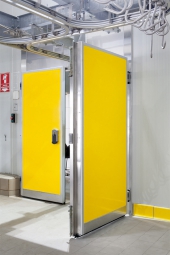





Better Door Control in Rail Zones
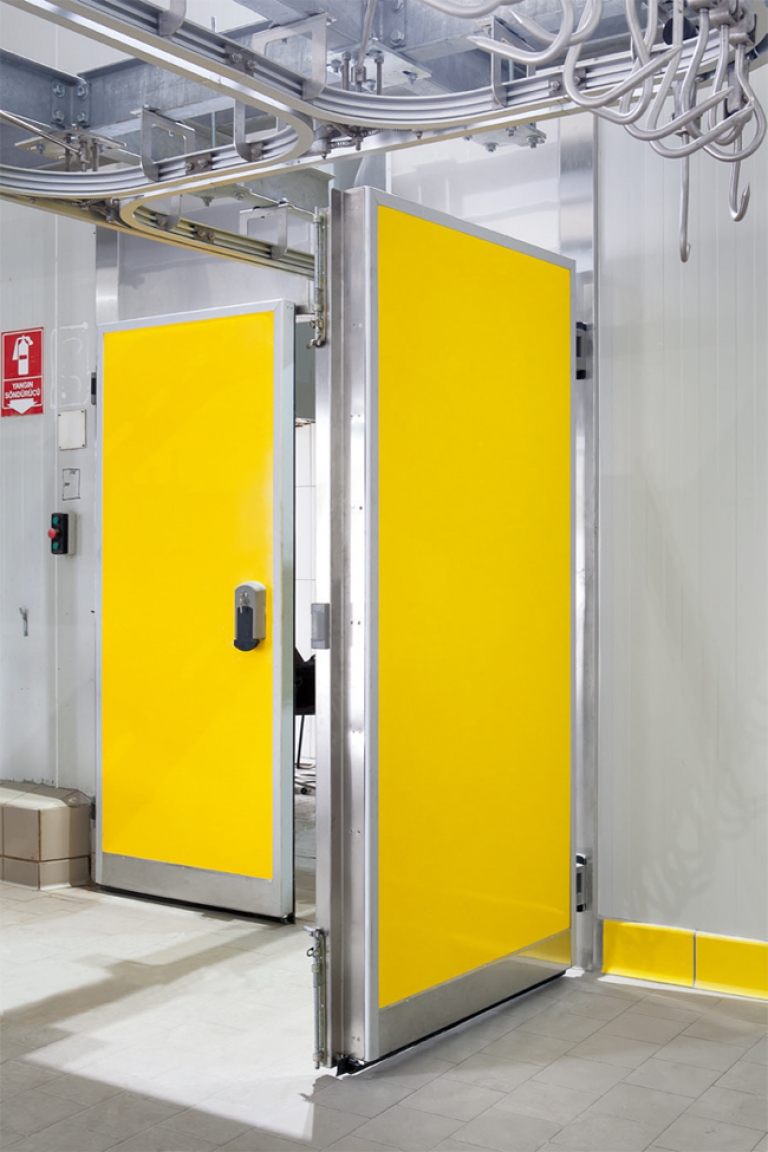
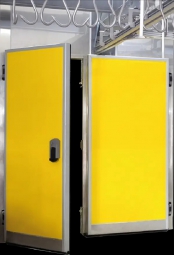
Monorail-Hinged Cold Room Door for Better Control in Rail Zones
Improve door control in rail zones with a monorail-hinged cold room door designed for safer opening motion, a cleaner workflow, and less maintenance in the long term.
Better Door Control in Rail Zones
When rail-based operations make door control more critical than a simple door opening, a monorail-hinged cold room door is often the right solution. In these openings, the main issue isn’t whether the door can open and close. The real issue is whether the door can be controlled cleanly, closed reliably, and used safely without obstructing suspended product flow, nearby personnel movement, or daily cleaning routines.
This is important because rail-guided systems are unforgiving. If the door feels unstable, awkward, or difficult to manage under actual operating pressure, the opening begins to create friction, impact, and premature wear in the workflow. A better solution is one that keeps the entrance predictable, durable, and easy to manage every day.
The Problem Starts When the Door Opening Feels Uncontrolled
In many refrigerated facilities, a door is evaluated solely for its fit and insulation at a very early stage. This may work for a simple access point. However, problems begin when the opening is located within a rail zone.
When suspended product movement, personnel traffic, vehicles, and cold room discipline share the same space, the door’s behavior becomes a daily operational issue. A door that swings too freely, closes inconsistently, or disrupts the natural flow of movement around the opening soon begins to feel like the room’s weak point.
This is particularly true in environments such as meat processing, food production, preparation areas, supermarket backrooms, and cold storage work areas where overhead tracks dictate how the space is used. In these environments, people do not view the opening as a design detail. They perceive it as part of the workflow.
That is why control is crucial. A door without control in a track-mounted area may still function, but it typically leads to small, recurring issues: hesitant movement, odd approach angles, unnecessary contact, irregular closing, and more maintenance than the facility anticipates.
Why Is Door Control More Important in Track-Mounted Areas?
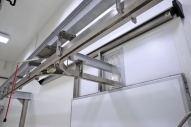
In a track-mounted area, the door opening is part of a motion system. It is not merely a panel resting on hinges.
The Swing Path Must Be Predictable
In areas with overhead track movement, users must be able to rely on the door’s behavior. If the panel opens too abruptly, feels awkward to use, or disrupts the natural path of the opening, traffic slows down immediately. Predictable door behavior supports faster and smoother movement.
The Entrance Must Support Multiple Movements Simultaneously
A track zone typically combines suspended product movement with personnel access and support equipment operations. This means the door cannot behave like a simple low-pressure opening. It must remain manageable in an area where multiple movement types are always present.
Closing Discipline Affects More Than Just Temperature
Reliable closing is important for thermal performance, but it also affects the workflow in rail-guided areas. A door that does not return properly or close consistently leads to rough handling, longer open durations, and a more chaotic access pattern. This weakens overall control of the area.
Hygiene and Presentation Depend on Controlled Operation
In refrigerated food facilities, opening should feel intentional and stable. A door that slams, slides, bounces, or is repeatedly struck—which is difficult to control—will not support the hygienic, inspection-ready standard the room is expected to maintain.
The Risk of Poor Door Control During Opening
Poor control does not always result in a single obvious failure. More often, it creates a series of small operational costs.
Slowing Down Traffic Through the Entrance
When staff do not trust the door’s behavior, they slow down. They adjust their paths, use the door more carefully, or wait for a more opportune moment. These repeated seconds accumulate over a shift.
Increased Contact and Wear
A poorly controlled door tends to be exposed to more impact. Door edges, bottom panels, hinges, latching points, frames, and surrounding trim are subjected to greater wear when movement around the door becomes less predictable.
Premature Wear on Hardware
Uncontrolled or inconsistent door behavior typically leads to more demanding use over time. This can result in premature stress on hinges, lock wear, seal deterioration, and repeated alignment adjustments.
Weaker Hygiene Flow
If the entrance becomes difficult to pass through or manage during washing and cleaning activities, hygiene routines become less effective. In food-related operations, this is no minor inconvenience. It affects labor time, visible cleanliness, and long-term suitability.
Faster Loss of Confidence in Accessibility
One of the most obvious signs of a poor access decision is when the facility begins to navigate the opening not naturally, but with caution. This typically means the door functions technically, but never quite feels right in use.
The Truly Useful Comparison
For rail-based systems, the useful comparison is not merely between one insulated door and another. The more valuable comparison is between a standard access plan and a door plan specifically designed for control.
| Decision Factor | Standard Hinged Door Planning | Monorail Hinged Door Planning for Better Control |
|---|---|---|
| Swing behavior | Basic opening-and-closing function | Predictable movement in a rail-influenced zone |
| Traffic management | Acceptable in simple layouts | Better suited to shared movement areas |
| Closing consistency | May vary under pressure | Better aligned with controlled daily use |
| Impact exposure | Often discovered later | Reduced through better door behavior |
| Hygiene support | Depends on general fit | Stronger when the opening stays orderly |
| Long-term ownership | Can become reactive | More stable when control is built in |
The key decision point is this: the right door is not just one that fits the opening, but also one that keeps the opening under control during daily use.
The Right Solution Starts with How the Opening Behaves
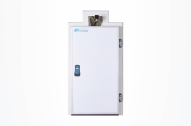
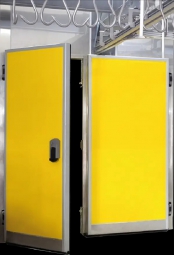
A single-track hinged cold room door is generally a better choice in situations where the opening serves regular yet controlled access, the overhead track alters the door’s operating mechanism, and the facility requires a reliable insulated entrance that does not become difficult to manage over time.
The strongest result comes from planning not just around the opening, but around control.
The Opening Direction Must Match Actual Traffic Flow
This is one of the most important decisions regarding the opening. If the door opens in the opposite direction of the natural movement of personnel or support equipment, the opening will never feel fully under control. The correct opening direction should reflect how the area is actually used throughout the day.
Door Movement Should Feel Firm, Not Loose
In rail-guided systems, users benefit from a door that feels intentional and manageable. The opening should not cause hesitation or require constant adjustment. Good control begins with a door that moves in a way people can predict and trust.
Hardware Must Be Selected to Withstand Repeated Pressure
Hinges, latch behavior, gaskets, frame strength, edge protection, and closing consistency determine how controlled the opening remains over time. These are not minor details in an active rail-guided area. They are part of the access strategy.
Threshold and Floor Transition Still Affect Control
Even if a door has an acceptable top clearance, control may still feel weak if the bottom transition is poor. In areas where vehicles, pallet jacks, or racks move near the opening, the floor’s behavior directly affects how smooth and manageable the entrance feels.
Cleanability Must Be Part of the Plan
A controlled opening must also be easy to clean and visually orderly. In refrigerated food environments, the door opening must support both movement and hygiene without becoming a difficult-to-maintain area.
This is where the Freezewize Refrigeration System approach adds value. Instead of treating the door as a standalone product, the opening is considered an integral part of the entire work environment. In rail-guided areas, this leads to better control over time, greater durability, and fewer ownership issues.
Quick Decision Guide
A single-track hinged cold room door is generally a better choice in the following situations:
- If the opening is located within or adjacent to an active track area.
- If personnel frequently use the door within a controlled traffic flow.
- Consistent door behavior is critical for safety and workflow.
- Hygiene, closing reliability, and visible order are important.
- The facility requires durable, insulated access without unnecessary operational friction.
- Long-term maintenance predictability is a factor in the purchasing decision.
The decision should be reviewed more carefully in the following situations:
- If the opening serves continuous high-speed, multi-directional traffic.
- Large equipment movements dominate the area.
- The door panel will disrupt traffic flow even after adjustments.
- The access point is expected to remain open for extended periods.
- Another access strategy would provide better operational control.
A simple rule applies here: If rail activity changes how the opening should be managed, the door should be selected not just for the opening but for control.
Related Solutions
This topic is naturally linked to nearby refrigerated area decisions, including the following:
- Heavy-duty cold room door systems.
- Freezer room doors for high-traffic access points.
- Hygienic equipment packages for food facilities.
- Insulated service doors for refrigerated work areas.
- Threshold details for pallet jack and hand truck traffic.
- Viewing panel options for safer entry visibility.
- Cold room wall and ceiling panel systems.
FAQ
What does better door control in a rail-tracked area mean?
It means the door moves predictably, closes reliably, and provides safe, trouble-free operation without obstructing nearby overhead rail movements or daily traffic.
Why is control more important than it appears?
Because a poorly controlled door may still function, but it leads to repeated hesitation, increased contact, weaker closing discipline, and earlier maintenance demands.
Can a standard hinged cold room door still function in some rail-tracked areas?
Yes, it can function under lighter load conditions. However, in situations where rail-tracked operations dictate how people and equipment move around the opening, a standard design typically creates unnecessary friction.
Does door control help reduce maintenance?
Yes. Better control typically means fewer preventable collisions, more consistent closing, lower hinge stress, and fewer repeated adjustments.
Is this primarily a safety issue or an efficiency issue?
Both. Better control provides safer movement, smoother workflow, better hygiene flow, and more predictable operational performance.
What is the most common planning mistake?
The most common mistake is treating the opening like a standard insulated door and failing to assess how the door should behave within a work zone affected by the tracks.
Conclusion
Better door control in track zones is not a minor improvement. This is what ensures the cold room opening remains usable, stable, and professional under actual operating pressure. Even if the door fits the opening, if it cannot be controlled during daily use, this is not the right long-term solution.
The strongest results are achieved by planning the door opening based not just on dimensions, but on behavior. If your project includes an active track zone, evaluate the opening direction, closing consistency, traffic flow, hygiene requirements, and long-term wear before finalizing the access point.