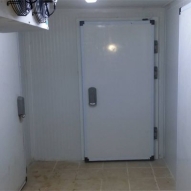





Cold Room Doors That Clear Track
Monorail Hinged Cold Room Door for Better Track Clearance in Cold Storage
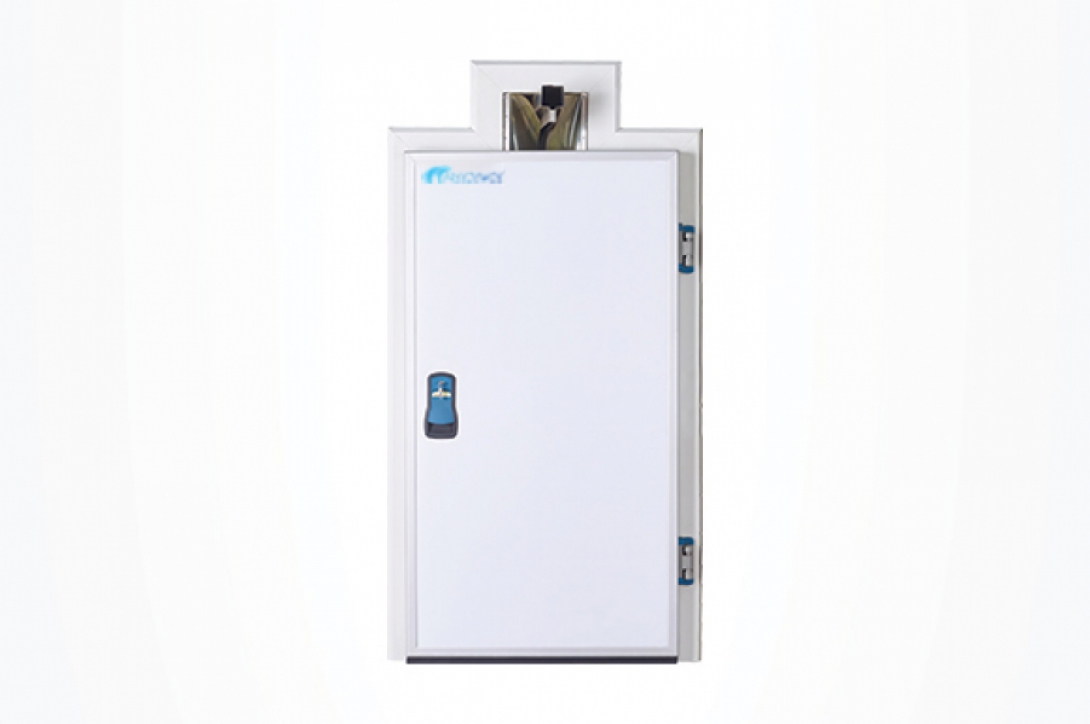
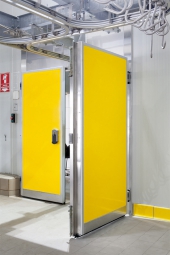
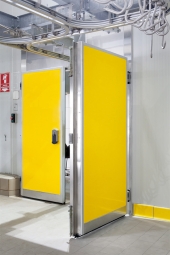
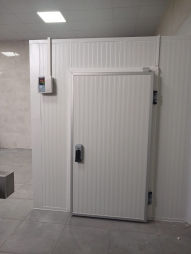
A monorail hinged cold room door improves access where overhead track systems limit door swing, helping reduce workflow friction, damage risk, and long-term maintenance pressure.
Cold Room Doors That Clear Track
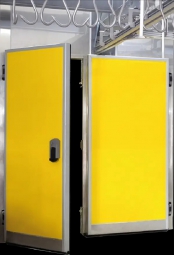
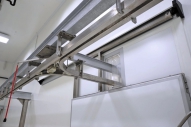
A monorail hinged cold room door is the right access solution where an overhead rail system puts pressure on the doorway opening. In meat processing, food production, cold storage, and operations with suspended product flow, a standard door setup may technically close the opening, but it often fails to solve the space in a practical way.
The real issue is not simply whether the door opens. It must clear the rail system safely, avoid slowing personnel movement, prevent unnecessary friction for cart and rack traffic, support hygiene routines, and hold up without creating long-term maintenance pressure. The right choice is not the door that fits the opening. It is the door that fits the operation.
The Problem Starts Not with the Opening, but with Obstruction
In many cold room projects, the access point is treated as a secondary detail. However, in ceiling-mounted monorail systems, the door is not merely a simple closure element on the wall. If chosen incorrectly, it becomes a daily friction point that repeatedly slows down workflow.
In many U.S. facilities, the same pressures emerge simultaneously: personnel movement continues, product flow remains active, hygiene standards must be maintained, the back area must look orderly, and the door is used repeatedly throughout the day. In such an environment, a standard swing-door approach may seem acceptable on paper, but it begins to create problems in actual use.
The problem becomes more pronounced under the following conditions:
- There is an overhead rail carrying products.
- Personnel traffic is heavy near the opening.
- Carts, shelves, or pallet jacks pass through the same area.
- An open door reduces the available workspace.
- Cleaning routines are frequent and aggressive.
- The door is part of an active work area exposed to impact.
Therefore, the real question is not just which door to use. The real question is: Does the door obstruct the rail system and does it facilitate daily operations?
The Hidden Cost of the Wrong Choice
A door may be installed and open and close properly, yet it can still be the wrong decision. This situation is common with monorail systems because a technically functional solution is not always the right operational solution.
The most common consequences of choosing the wrong door are as follows:
Constant Slowdown in Workflow
If the door barely clears the track or narrows the usable opening during operation, every passage causes a small delay. This friction may not be noticeable at a single moment, but it leads to significant time loss over the course of a shift.
Hardware and Surface Damage
The door panel, frame, hinges, vision panel, or bottom edge are exposed to impacts in high-traffic areas. When adequate clearance is not provided, users tend to open the door more cautiously or clumsily. This reduces ease of use and accelerates wear and tear.
Poor Hygiene Standards
Complex joint details, improperly positioned hardware, or surfaces showing repeated impact marks can lower the perceived hygiene of the cold room area. In facilities under food safety and regulatory scrutiny, this is not merely a cosmetic issue.
Deteriorating Temperature Discipline
If the door becomes annoying during daily use, staff may leave it open longer than necessary, use it more aggressively, or view proper closing as a secondary concern. This situation quietly undermines temperature control and energy performance.
Increasing Maintenance Pressure
A poor decision may seem tolerable for the first few weeks. However, over time, alignment issues, seal wear, hardware loosening, and surface deformation create recurring tasks for the maintenance team. The real issue isn’t just the repair cost. Ultimately, you’re left with a door that requires constant attention.
The True Decision Point for Track Clearance
In areas where track clearance is critical, the decision isn’t simply between a hinged door and another door type. More importantly, it concerns how the door interacts with the overhead system.
A single-track hinged cold room door is typically the right solution in the following situations:
- If the opening is used frequently but in a controlled manner.
- If the track line affects the upper part of the door opening.
- If personnel access and the flow of suspended products share the same general area.
- The swing direction can be planned according to the actual site layout.
- Durability and ease of use are both important.
- Cleaning and service access should be simple.
The goal is not simply to fit the door under the track. The goal is to ensure the door operates safely without interfering with the track and without turning the entry point into a bottleneck.
Quick Comparison
The table below helps clarify the selection logic:
| Decision Factor | Standard Hinged Cold Room Door | Monorail Hinged Cold Room Door |
|---|---|---|
| Overhead track clearance | May be limited | Planned around the track system |
| Daily access flow | May conflict with site conditions | Offers a more controlled access pattern |
| Impact risk management | May remain basic | Can be built more appropriately for active-use areas |
| Cleaning and hygiene suitability | Depends on the detail level | Can be adapted more deliberately to the site |
| Long-term maintenance | Increases in the wrong application | Becomes more predictable in the right setup |
| Cold room suitability | May be enough for general use | Better suited for access beneath tracks |
This table alone does not make the decision, but it highlights the fundamental difference: the issue is not just the type of door, but the door’s operational geometry.
How to Create the Right Solution
The right solution does not start by selecting a product from a catalog. It begins with understanding how the opening is actually used. Then the door is designed around this reality.
The Opening Direction Must Follow the Workflow
In many projects, the question of which direction the door should open is taken lightly. However, in a single-track system, the wrong opening direction can turn even a well-made product into a daily problem. Personnel flow, approach direction, and equipment movement must be evaluated together.
Ceiling Clearance and Track Proximity Must Be Clearly Calculated
Track clearance may appear sufficient on paper, but in actual use, the door’s approach angle, sash movement, and hardware positioning become more critical. In high-traffic areas, theoretical clearance does not equate to comfortable use.
Hardware Durability Must Be Suitable for the Environment’s Demands
Hinge construction, latch behavior, seal quality, edge protection, and, when necessary, the configuration of the viewing panel determine how long the door will remain reliable. These are not merely technical specifications; they directly impact daily operational quality.
Threshold and Floor Transition Must Be Evaluated Separately
In areas with pallet jacks, service carts, or shelf movements, the door cannot be evaluated in isolation. If the threshold detail, floor transition, and bottom edge behavior are not evaluated together, user friction begins immediately. At this point, not only is the door poorly designed, but the entire access point becomes compromised.
Hygiene Requirements Must Be Defined Early
In food processing, supermarket preparation, commercial kitchens, and controlled cold storage environments, the door’s appearance is not the only concern. Cleanability is also a critical decision factor. Therefore, surface selection, a simple joint design, and easy maintenance access are essential.
At this point, the Freezewize Cooling System approach treats the door not as an independent product but as an integral part of the operation. In rail-mounted applications, good results stem not merely from technical specifications but from suitability for the application.
What Really Shapes the Decision
One of the most common mistakes made by professional buyers is assuming that clearance dimensions are sufficient to guide the decision. In reality, the following factors are more important for a cold room door under a monorail system:
- How many times per hour the door will be used.
- Whether users are only personnel or also carry equipment.
- Whether the opening is inside or next to the production line.
- Whether the risk of impact is low, medium, or high.
- Whether the area is washed regularly.
- How important visual order and readiness for inspection are.
- How critical proper closing behavior is.
- Whether maintenance tolerance is low or acceptable.
If these questions are not answered, the selection often remains at the “good enough for now” level. Over time, the same door begins to create issues with non-compliance with facility standards and ownership costs.
Quick Decision Guide
A single-track hinged cold room door is generally a better choice in the following situations:
- If there is an active track system above the opening.
- A standard hinged door approaches the track and impedes ease of use.
- If personnel access is regular but not chaotic.
- If hygiene, cleanliness, and reliable closing are important.
- If there is a risk of impact, but the opening is not a point of constant heavy industrial traffic.
- If the need to reduce long-term maintenance pressure exists.
The decision should be reviewed more carefully in the following situations:
- If traffic is both heavy and multi-directional.
- The opening serves the movement of large equipment.
- The door panel’s opening path disrupts the work rhythm.
- The passageway tends to remain fully open for extended periods.
The key decision statement is: If the track opening is part of the requirement, the door should be selected not only based on the opening’s dimensions but also on how the opening is used.
Related Solutions
In many projects, this issue should not be evaluated in isolation. The following internal page opportunities are naturally related to this content: ****
- Heavy-duty cold room door systems.
- Freezer room doors for high-impact areas.
- Cold storage wall panels.
- Insulated service doors for food processing facilities.
- Cold room threshold details for vehicle traffic.
- Viewing panel options for refrigerated doors.
- Hygienic equipment solutions for processing areas.
FAQ
Which single-track hinged cold room doors are most suitable for which facilities?
It is particularly suitable for food processing areas with suspended product lines, cold storage access points, preparation areas, and facilities requiring controlled personnel access.
Why is the track clearance so important?
Because it’s not just about whether the door opens or not. If it cannot pass safely through the track system, workflow slows down, the risk of collisions increases, and daily use becomes cumbersome.
Can a standard hinged door still be sufficient in some facilities?
Yes, in some cases it can. However, in real-world use, where the overhead track creates constant friction, technical adequacy does not necessarily mean the decision is operationally sound.
Is a sight panel necessary?
Not always. However, in areas where personnel traffic, approach risk, and clear visibility are critical, a sight panel can enhance awareness and passage safety.
What maintenance areas typically require attention in these types of doors?
Maintenance focus typically centers on hinge behavior, closing discipline, seal performance, surface damage, and areas prone to repeated impact.
How can long-term costs be controlled?
With proper opening geometry, appropriate hardware strength, a cleanable surface structure, and threshold details suited to the space, both maintenance burden and the risk of premature replacement can be reduced.
Conclusion
Cold room doors that stay off the track are not merely doors that do not touch the track. They are access solutions that operate without slowing down the process. If a door stays clear of the track but makes daily operations difficult, the decision may be technically acceptable but operationally incorrect.
In cold room projects with monorail systems, the safest approach is to focus not on the opening motion but on the actual operational demands. To plan the access point more effectively, evaluate traffic flow, hygiene requirements, impact risk, and maintenance tolerance together.