




Cold Room Entries That Resist Wear
Cold Room Entries That Resist Wear | Stainless Steel Door Guide
Reduce wear, protect workflow, and extend cold room entry life with a stainless steel hinged cold storage door built for daily traffic and hard use.
Cold Room Entries That Resist Wear
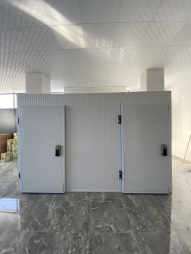
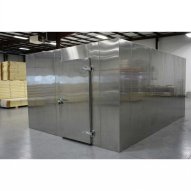
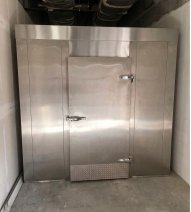
A cold room entry that resists wear is not just a tougher-looking door. It is an opening designed to keep working under daily staff movement, cart contact, threshold pressure, repeated cleaning, and constant temperature separation demands. In many facilities, a stainless steel hinged cold storage door is the right answer when the opening must stay dependable without turning into a maintenance issue.
That matters because wear usually shows up at the entry long before the rest of the room starts failing. Edges get hit, thresholds get dragged, seals lose consistency, and hardware begins carrying more stress than expected. When that happens, the door opening stops supporting the operation and starts slowing it down.
The Entrance Typically Wears Out Before the Room
In real cold storage environments, the first noticeable weakness is usually not the panel system or the refrigeration equipment. It’s the entrance.
This makes sense when you consider how the entrance is used. Staff pass through here throughout every shift. Carts bump into the frame. Shelves pass through with very little clearance. Pallet jacks hit the thresholds. Handles and latches are subjected to repeated pressure. The bottom edge is exposed daily to dirt, moisture, impacts, and washing. A door that seemed acceptable during installation may begin to wear out much faster than the rest of the room around it.
This is particularly true in cold rooms, refrigerated preparation areas, food service backrooms, supermarket support areas, and processing areas—where the entrance is not just a boundary but an integral part of the workflow. Once wear begins at the opening, its impact rarely remains limited. It extends to cleaning time, sealing performance, maintenance planning, and user confidence.
Therefore, buyers should address entrance durability not merely as a material choice but as an operational issue.
Wear Creates Friction Long Before Failure Occurs
One of the most costly mistakes in cold storage planning is waiting for an obvious failure to occur before realizing the entrance was the wrong choice.
Most worn-out openings do not fail suddenly. They become increasingly difficult to manage. The door still closes, but it no longer feels secure. The threshold still functions, but it accumulates damage and slows movement. The surface still appears usable, but it begins to show signs of premature wear. Teams try to compensate for this situation without realizing how much time and attention the entrance requires.
This friction typically manifests as follows:
- Slower movement during busy shifts.
- Repeated contact damage on edges and trim.
- Increased maintenance requirements for hinges, latches, and gaskets.
- More cleaning effort around worn surfaces and thresholds.
- Replacement time coming sooner than originally planned.
- A growing sense that the entrance is inadequate for the job.
A door doesn’t have to be completely broken to become costly. In many facilities, simply wearing out faster than expected is enough.
Why Wear Resistance Matters More in Daily Operations
Cold room entrances are located where thermal separation intersects with human movement. This sets them apart from most other room components.
An entrance must maintain the room’s boundary, yet also withstand daily rough use without losing reliability. If a door starts to rub, becomes misaligned, wears excessively, or accumulates preventable damage, the issue quickly becomes operational. Staff notice it. The maintenance team notices it. When the area begins to look more worn than it should, managers notice it too.
Wear resistance is the most critical factor in facilities dealing with the following:
- Frequent employee traffic.
- Hand truck and shelf traffic.
- Pallet jack traffic.
- Regular cleaning and washing.
- Visible back-of-house standards.
- Low tolerance for downtime or service interruptions.
In these environments, a lighter-duty entrance may seem economical at first, but it can end up being costly in the long run.
Hinged Doors Still Make Sense When Done Right
In many commercial and industrial cold rooms, the hinged door remains the most practical option. It is straightforward, familiar, easy to use, and well-suited for controlled yet frequent movements.
This is particularly true in situations where the opening serves people, hand carts, wheeled racks, and routine product handling rather than uninterrupted automated traffic. A hinged design can provide reliable access without creating extra operational complexity. The challenge here is not the hinged format itself. The challenge is whether the entrance is durable enough to withstand the facility’s actual pace of work.
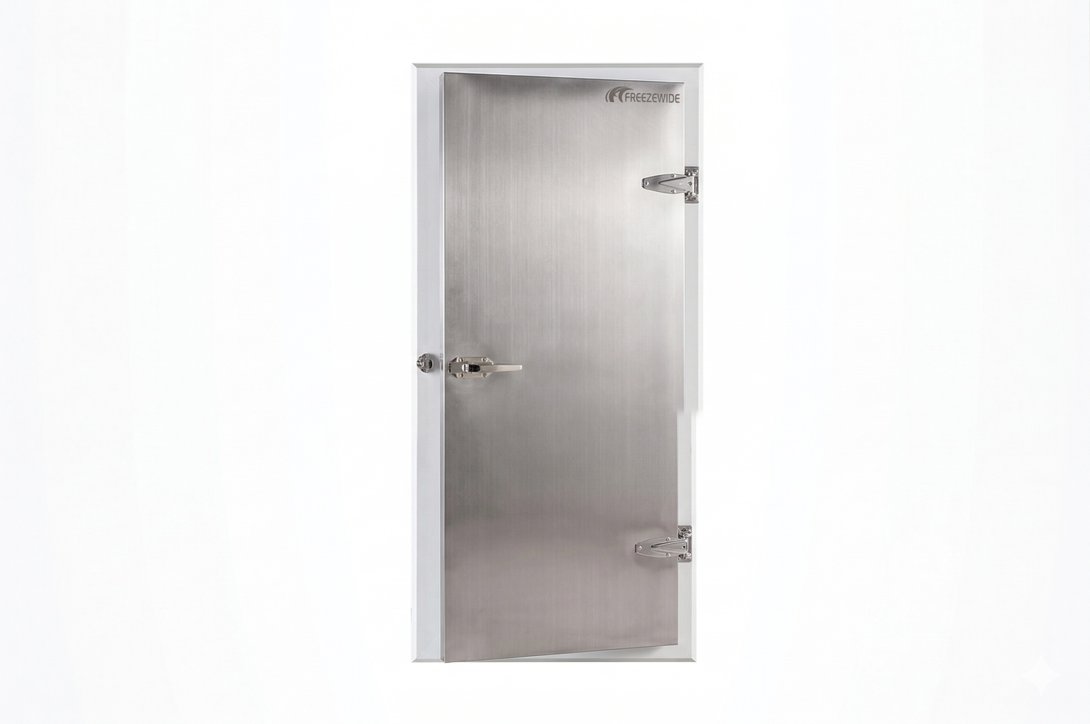
A stainless steel hinged cold storage door is often the logical choice here because it combines a simple access style with a surface and structure better suited for demanding daily use. When the room requires an opening that can withstand impacts, supports cleaning, and maintains its appearance over time, this feature becomes easier to justify.
Wear-Resistant Entry vs. Standard Opening
When buyers compare options, the main difference is usually not whether the door is insulated. The main difference is whether the entry is suitable for withstanding daily harsh conditions without wearing out too quickly.
| Decision Area | Stainless Steel Hinged Cold Storage Door | Standard Lower-Duty Entry |
|---|---|---|
| Surface durability | Better suited for repeated contact and daily cleaning | More likely to show wear sooner |
| Traffic tolerance | Stronger fit for frequent staff and cart use | Often better only for lighter use |
| Threshold pressure | Better suited to real operational crossing stress | More likely to feel tired earlier |
| Maintenance burden | Helps reduce recurring wear-related attention | Can create more frequent adjustments and upkeep |
| Visual longevity | Holds a more controlled appearance over time | Often shows fatigue faster |
| Ownership logic | Stronger long-term value in demanding rooms | May seem cheaper only at purchase |
Therefore, the term “wear-resistant” should not be dismissed as a vague sales slogan. In cold storage facilities, this is a measurable ownership issue.
An Opening Must Be Built as a Functional System
A durable entrance is never just a durable door panel. Wear resistance comes from the entire opening.
This includes the frame, hinges, latch hardware, threshold condition, gasket design, kick plate, vision panel selections, and how the entrance integrates with the surrounding insulated panel system. If a weak component is subjected to repeated stress, the entire opening will experience performance degradation faster than expected.
A cold room entrance with greater wear resistance typically includes:
- Stainless steel surfaces for environments with increased contact.
- Hardware selected for repeated daily cycles.
- Threshold details resistant to hand truck and pallet jack movements.
- Seal systems that maintain functionality even when frequently compressed.
- Protective features where impact is foreseeable.
- Viewing panels that reduce accidental contact by enabling safer movement.
- A layout that adapts to the room’s actual traffic flow.
This is where project evaluation becomes critical. The Freezewize Cooling System typically treats the entrance as an integral part of the room’s operational layout; because when traffic, hardware, floor transitions, and surrounding panel conditions are evaluated separately, a door opening cannot demonstrate sufficient resistance to wear and tear.
Choosing for Real-World Traffic, Not Ideal Conditions
A common specification error is selecting the entrance based on ideal usage rather than actual usage.
Traffic may appear moderate on paper. In practice, however, the entrance is subjected to constant movement at the same points every day, rushing personnel, loaded carts, wet floors, and repeated contact. This discrepancy between assumed and actual usage is often where premature wear begins.
A better decision is made by asking practical questions:
- How many times a day will the entrance open and close?
- Will vehicles, pallet jacks, or racks pass through regularly?
- Will the threshold be exposed to repeated impacts?
- Is the area washed frequently?
- Is the entrance easily visible to inspectors, managers, or customers?
- Does the facility prioritize low maintenance costs or merely acceptable short-term functionality?
These questions typically reveal whether a more wear-resistant structure is needed from the outset.
The Right Solution for Heavy-Duty Cold Rooms
When the entrance is part of a workflow with heavy traffic, the safer long-term choice is usually a stainless steel hinged cold storage door designed to withstand real-world daily challenges, rather than a standard room partition.
This is generally a more suitable option for:
- Food preparation and processing support rooms.
- Supermarket refrigeration and freezer backrooms.
- Commercial kitchen cold rooms.
- Refrigerated preparation areas.
- Distribution support entrances.
- Work areas with daily handcart or shelf movement.
In these situations, the entrance should not be viewed as a simple opening. It should be considered an operational component that must maintain workflow, maintain alignment, support cleanliness, and resist visual and physical wear over time.
A simpler door may still be suitable in a low-traffic area. However, in areas where the entrance is exposed to repeated contact and constant movement, a more robust design generally better protects the budget over the room’s lifespan.
Quick Decision Guide
Choose a stainless steel-hinged cold storage door when the entrance must withstand repeated use, regular contact, and visible daily wear without requiring frequent maintenance.
It is generally the right choice in the following situations:
- Staff pass through the opening throughout the day.
- Vehicles, shelves, or pallet jacks regularly cross the threshold.
- The room is cleaned frequently.
- The entrance is visible and expected to look presentable.
- Maintenance tolerance is low.
- Long-term ownership value is more important than the lowest initial purchase price.
In the following situations, a lower-performance entrance door may be sufficient:
- If traffic is limited.
- If the risk of impact is low.
- If the threshold is subjected to minimal stress due to passage.
- If the area is not highly visible.
- If cleaning demands are moderate.
- If replacement timing is not critical.
If the opening is part of the daily workload, it should not be considered a low-traffic access point; it must be specified to withstand wear and tear within normal operating conditions.
Related Solutions
If wear resistance is central to the purchasing decision, the following related solutions are typically worth considering alongside the entrance itself:
- Heavy-duty cold room doors.
- Freezer room door solutions for more demanding thermal environments.
- Sanitary cold room panel systems.
- Threshold details for hand truck and pallet jack traffic.
- Impact protection for door edges and surrounding walls.
- Heavy-duty hardware packages for cold storage entrances.
- Seal and gasket systems designed for high-cycle use.
- Viewing panel options for safer movement and fewer collisions.
These details often determine whether an entrance will maintain its reliability over time or begin accumulating preventable damage early on.
FAQ
What causes cold room entrances to wear out faster than expected?
Frequent traffic, contact with hand trucks and pallet jacks, repeated cleaning, threshold stress, equipment cycles, and poor alignment between the opening and actual workflow are the most common causes.
Are stainless steel hinged doors better for high-traffic cold rooms?
In most cases, yes. They are generally better suited for demanding daily use because they offer a more durable surface and stronger long-term performance in high-contact environments.
Does wear resistance depend solely on the door surface?
No. Wear resistance also depends on the hinges, latches, thresholds, gaskets, frame strength, protective details, and how well the entrance aligns with the room’s traffic flow.
Can a door still be the wrong choice even if it maintains temperature properly?
Yes. If the entrance causes friction in workflow, visible wear and tear, repeated maintenance needs, or pressure for early replacement, it can still be an operational misfit—even if it has acceptable thermal performance.
When should buyers switch to a heavy-duty entrance?
If the opening experiences frequent daily cycles, regular handcart or shelf movement, repeated cleaning, or constant threshold impact, a heavy-duty option is generally advisable.
Which part of the opening is most prone to wear and tear?
Thresholds, the bottom edges of the door, latch areas, hinges, and frame contact points typically absorb the majority of daily stress. Therefore, the entire opening must be evaluated as a whole.
Conclusion
Wear-resistant cold room entrances do more than just last longer. They maintain smooth operation, reduce maintenance burdens, and help the room continue to perform like a professional workspace.
If an entrance is subject to heavy daily use, it should be designed with wear resistance in mind from the start, rather than being repaired after friction has already occurred.
Whether you’re planning a new cold room or replacing a worn-out entrance due to daily traffic, it makes sense to review the entire entrance system before normal wear and tear turns into recurring costs and preventable downtime.